(Slightly) Earlier
The Disaster of Reformed Historiography of Art: Part 4

Author’s Note: This series originally began as an attempt to rebut Dr. Gavin Ortlund’s aniconic position. In the process of researching for this, I realized that the problems were deeper, older, and more pervasive than Ortlund. Rather than responding to Ortlund, I needed to provide a deeper treatment of the historiographic direction Protestant polemics has taken. That is why up until now I have not substantially addressed Ortlund’s presentations except in passing. There was a long-planted tree of historiography that needed to be revealed and uprooted before I could address Ortlund in full. With the previous three articles in mind, I will now turn directly to Dr. Gavin Ortlund.
My referencing of a scholar should not be taken as an endorsement of their claims or views. The intent is not to give an original analysis of the secondary literature, but simply to show you what it says and whether or not Ortlund accurately portrayed their opinions.
I ended the last article noting that Dr. Gavin Ortlund chose Carpenter’s Variant A translation of Elvira’s Canon 36 over Robin Jensen’s correct rendering of Variant B.
Now, we need to turn to this scholar that both Carpenter and Ortlund have treated as a witness in their attempted vindication of the Reformed historiography of art:

Dr. Robin Jensen, PhD
Robin Jensen is the Patrick O’Brien Professor of Theology at the University of Notre Dame and one of the leading art historians on the topic of early Christian material culture. She has been teaching and writing on this subject for decades. Having published dozens of books and articles on early Christian art, she is mainstream, credible, and widely cited and respected in the field.
In her 2022 monograph From Idols to Icons, Jensen explicitly links the rise of relics with the parallel emergence of portrait-style icons. She places this key material turn in the latter half of the fourth century:
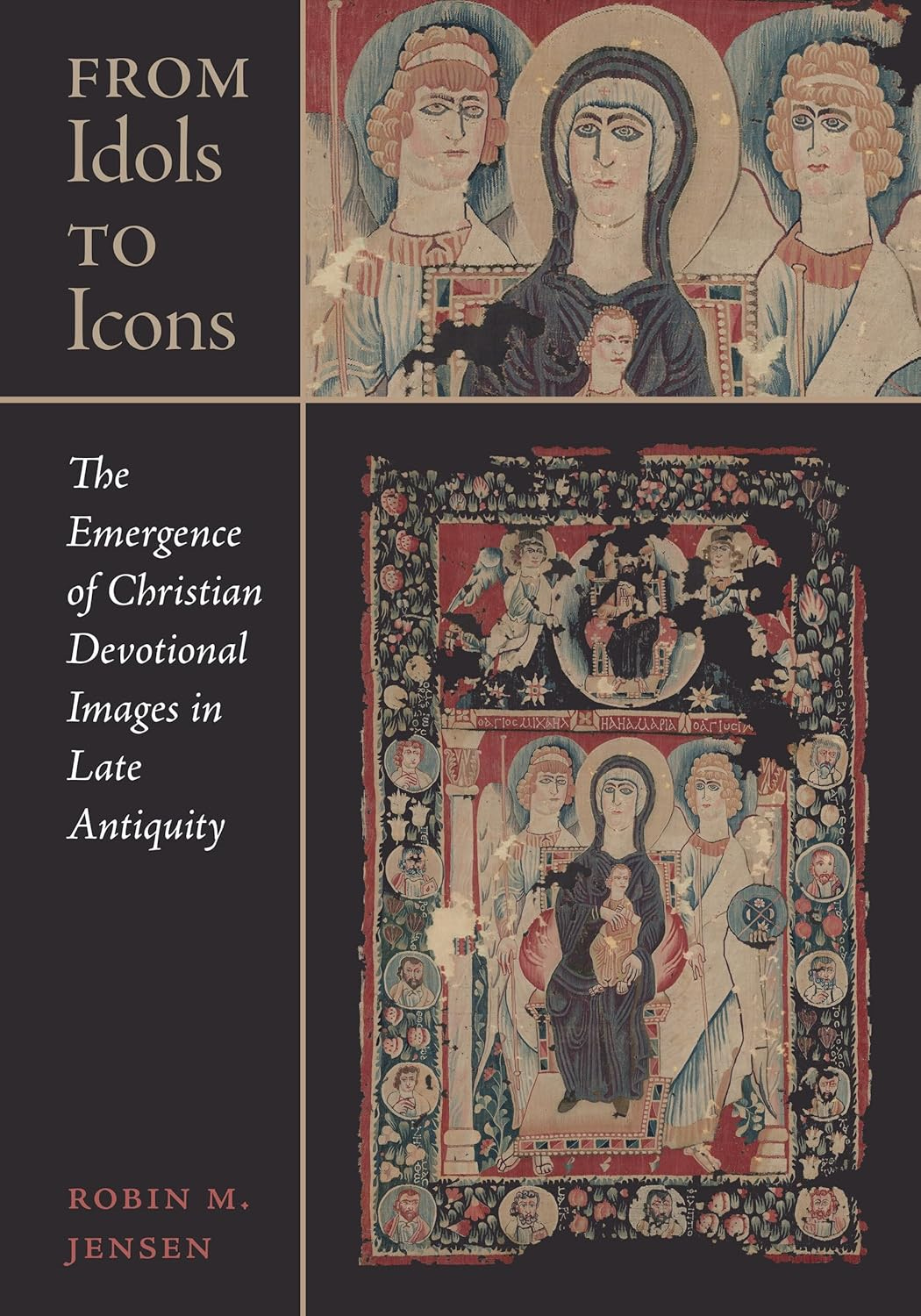
Some historians have argued that prior to the eighth century, any portraits of Christ or the saints were merely commemorative images or votive offerings rather than objects of veneration and that no evidence supports a Christian cult of images earlier than the seventh century. This argument is partly based on the lack of recorded miracles attributed to icons or beliefs in their intercessory powers in the preiconoclastic period. This leads to the judgment that Christians did not perceive any direct links between the image and the model—that is, they did not have a theology of the image that understood a saint’s portrait as not just a likeness but actually a vehicle for directing prayers or offerings to the one it portrays. Yet the evolution, beginning in the late fourth or early fifth century, away from dominantly narrative images to more frontal, nonnarrative portraits of the saints and Christ, especially but not exclusively in church apses, suggests that viewers were also developing new ways of engaging figurative artworks, which would have included regarding them as focal points of both communal and private prayer.1
Dr. Jensen has also asserted this plainly in a public speaking event for Canadian Mennonite University in the same year. At this event, she was explicitly asked by an audience member when she dates the emergence of portrait images and their veneration in Christianity. This is Jensen’s response2:
Around the middle of the fourth century, a really amazing thing happens within Christian practice. It’s what historians have now started to call the ‘material turn.’ What this means is that things like relics and pilgrimage—and I would add to this icons, which makes some of my art history friends very upset—happen around the same time. I’m not quite sure of all the reasons why this happened. I wrote a whole book trying to figure out the answer, and I have to confess the deep, horrible secret: I don’t have an answer. I didn’t answer the question I set out to ask. But all of a sudden it’s like Christians…wanted something tangible. They began going to tombs; nobody went on a pilgrimage to the Holy Land until about 315, shortly after Constantine began building the site at Jerusalem. Sacred places, and making bodily pilgrimages to those places, picking up dirt from those places, bringing back water from those places, collecting the remains of a saint, holding on to the tears of the Madonna or whatever—all of this begins to happen around the same time. It’s the same time that we see the shift from mostly narrative images into mostly portrait images, and we see that people are in fact beginning to venerate portrait images, to offer prayers in ways that they didn’t before, probably. And that’s a whole movement. Maybe beginning—the earliest thing we can say about relic veneration is around 360. So it’s pretty late relative to my world (late), and in your world probably really, really early, but it’s an important change.”
1:02:29–1:04:39
So as we begin our analysis, it should be acknowledged that it was on the public record from her own mouth and monographs by 2022 that Dr. Robin Jensen:
Argues that the 20th century aniconic consensus should be rejected and that early Christians were attacking the pagan use of pagan images. The in-house discussion and criticism of Christian imagery began in the fourth century. Because of this, early church writers should not be used as markers for early Christian attitudes towards art.
Placed the emergence of icon veneration alongside the rise of relics at the earliest to 360, the latter half of the fourth century.
Already, it should feel jarring to the reader to see a mainstream, prominent scholar in the field of early Christian art asserting these two things at the same time that Christianity Today’s 2024 book of the year, What It Means To Be Protestant, said this:

In this chapter we will uncover the shocking truth that the position anathematized as damnable heresy at an ecumenical council was, essentially, the universal position of the early church. Not only does the veneration of icons manifestly not date back to the first century, the only question is whether it originated in the sixth or seventh century.3
It was certainly jarring for me.
In order to understand what went wrong, it is necessary for us to document in chronological order, the sequence of Ortlund’s scholarly misuse of Dr. Robin Jensen.
January 5th, 2023 - CLEARLY a 6th-7th Century Accretion

In January of 2023, Dr. Gavin Ortlund released his “Icon Veneration is CLEARLY an Accretion!” video. This is his first public citation of Robin Jensen at 21:33-22:104:
“Early Christians were not always opposed to all that, just general usage of art. What they opposed was the cultic usage of art—venerating it, praying to it, anything like that. This was seen to be, it’s universal without, and seemed to be the hallmark distinctive of what made Christian worship different from pagan worship. Here’s how Robin Jensen puts it:
‘The fundamental problem early Christian critics identified aimed less at the simple existence of iconic statues or paintings of the gods than on the ways viewers treated these objects. They identified idolatry with ritual actions more than with the objects themselves.’
Now this is tricky because you’ve got a spectrum of options…”
Ortlund cites Jensen’s 2021 article titled “Figural Images in Christian Thought and Practice” on page 114, which is the first chapter of A Companion to Byzantine Iconoclasm.
Do you remember the ellipsis error discussion from the “Myth of Early Christian Aniconism” article? If not, go back and read what an ellipsis error is. Ortlund is committing another ellipsis error here. The first sentence in the citation contains the word “Furthermore”.
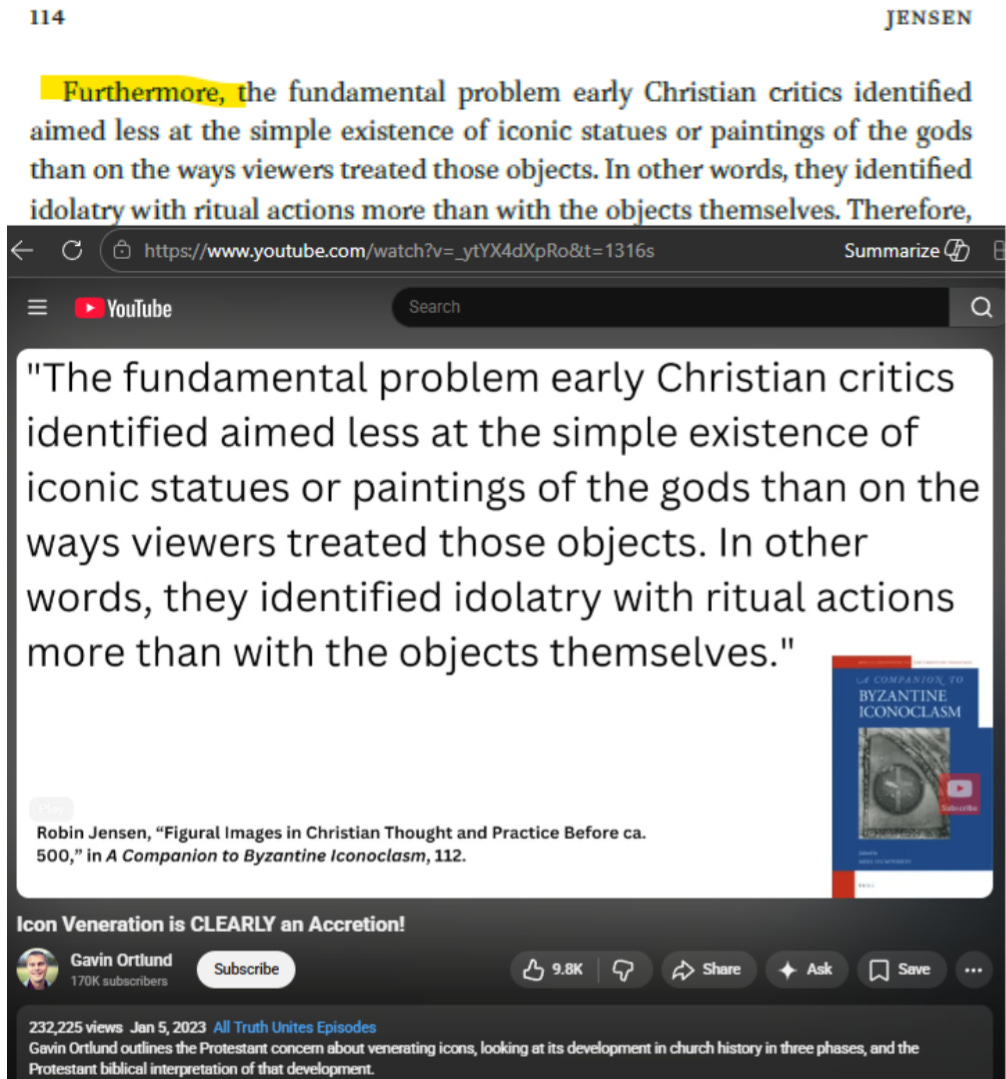
This means that the paragraph cited is following from the logic of the previous paragraph. Here is the complete passage restored for the viewer. You’ll find that it is similar to a passage of hers that I have cited in Part 1:
“Nearly all these scholars [Finney, Murray, Elsner, and Jensen] have noted that although early Christians never actually objected to pictorial art as such, surviving literary evidence overwhelmingly demonstrates that their spokespersons were extremely hostile to the veneration of pagan cult images. Thus, with very few exceptions, early Christian opposition to pictorial art was aimed at a specific type of image: depictions of divine beings and, in particular, representations of the Greco-Roman deities. Thus, Kitzinger’s crucial distinction between “harmless” symbolic or narrative art and “harmful” cult images is necessary to understanding early Christian attitudes toward visual art, because they were concerned only with non-Christian religious art, rather than images made by or for Christian edification, decoration, or devotional use. The internal criticism of Christian figurative images did not commence until Christians began to make their own sacred icons depicting holy persons (saints) as well as Christ.
Furthermore, the fundamental problem early Christian critics identified aimed less at the simple existence of iconic statues or paintings of the gods than on the ways viewers treated these objects. They identified idolatry with ritual actions more than with the objects themselves.”
Ortlund framed his argument around his citation of Jensen’s quote by first saying that Christians were opposed to the “cultic use of images”. This is not what Jensen says. According to Jensen, early Christians were “extremely hostile to the veneration of pagan cult images.”
Again, Ortlund says there was early Christian opposition to the “cultic use of images”
Jensen says there was early Christian opposition to “the veneration of pagan cult images”
Do you see the difference?
Jensen’s position is standard in the field of art history today. She does not assert that the second through third century writers that Ortlund will later cite in his video are making any statements about Christian use of images. She explicitly says that in her opinion, this internal conversation began much later. However, Ortlund has called this position, that early Christians were opposing pagan idolatry and ritual, a “rather convenient evasive maneuver:5
“Now some people will say, ‘Okay, yeah, there’s a lot of opposition to images in the context of worship—praying to images, venerating images, etc.—but they’re just opposing the pagan practice of that.’ Now, I think anybody who is paying attention to these quotes will see that that’s a rather convenient, evasive maneuver…”
In other words, Ortlund’s own cited source is arguing for the convenient evasive maneuver. Already, Ortlund’s first citation of Jensen falsifies the very thesis that he was citing Jensen to defend:
In this chapter we will uncover the shocking truth that
the position anathematized as damnable heresy at an ecumenical council was, essentially, the universal position of the early church.Not only does the veneration of icons manifestly not date back to the first century, the only question is whether it originated in the sixth or seventh century.6
Let’s look at his second citation of Jensen.
Later in the same video he declares that fourth-century portraiture was “Definitely not venerated.”7:
“Robin Jensen notes that:
‘Iconic portraits of apostles, saints, and Christ mostly appeared only toward the end of the fourth century.’
They’re still rare at this time and they’re definitely not venerated, but at least now there’s the possibility of that because you’ve got this flood of pagan converts coming into the church. So this is why we make the distinction here: because now you’ve got a new situation. What was previously just unimaginable—that Christians would be bowing down to images—now does need to be addressed. Here and there people will cross the line and the use of images will cross over into a cultic use of images, and when that happens you find these crackdowns from various church leaders.”
Here, he cites Jensen’s 2017 article, “Aniconism in the Early Centuries of Christianity”. Readers of the second part to this series will be familiar with what I am about to say next. Carpenter had it wrong years ago; Ortlund is unfortunately following in his footsteps.
Jensen notes in many other places that the material turn of Christianity in the late fourth century includes the veneration of portrait images. This is her position. To cite Jensen saying that portrait images appeared at the end of the fourth century, and then to follow up from the citation by saying that these portrait images were “definitely not venerated” completely misrepresents one of the fundamental points of Jensen’s long-standing thesis. The veneration of Christian images arose (according to Jensen) at the same time that Christian art transitioned from narrative art into sacred portrait art, in the later fourth century. I will even cite the same article Ortlund used:
“Augustine’s admission that members of his flock apparently engaged in some kind of image veneration indicates that Christians were not universally and consistently aniconic. Furthermore, the physical evidence shows that through the 3rd and 4th centuries, Christians became more and more apt to decorate their tombs and places of worship with figurative art. Although initially much of this art was narrative in character rather than iconic (and thus distinctly different from the kind of representation that would prompt worship to itself), portraits of Christ, the Virgin Mary, and the saints began to be common by the late 4th century began [sic] to prompt veneration.”8
Ortlund’s failure to assess Jensen’s opinion is further concerning in light of his third citation of her:9
“Jensen gives a helpful summary of the significance of this anecdote.
‘The exchange between Gregory and Serenus shows that the Christian problem with holy images is far more complicated than simply a matter of general disapproval of pictorial art. It also gives a more nuanced view of the gradual but inexorable inclusion of iconography in Christian worship spaces. Narrative images were never an evident problem and so were accepted from the beginning. The emergence of saints’ portraits in the fourth and early fifth centuries posed new problems insofar as these eventually came to be regarded as objects of veneration and a widely accepted component of Christian devotional practice.’
Okay, when does that happen? When do they start to become venerated? Well, as we’ve said, the general consensus is the sixth and seventh century.”
This is from Jensen’s 2017 article. When Ortlund quotes Jensen on fourth- and fifth-century portraiture eventually becoming objects of veneration, he immediately asks, “When does that happen?” and answers: the sixth or seventh century. There is no mention of Jensen’s opposition to this. This frames her as a part of the sixth to seventh century spectrum. She does not support this.
In her 2021 “Figural Images in Christian Thought and Practice,” Jensen describes Augustine’s preaching in 425 AD at the shrine of St. Stephen in Hippo. In the sermon, Augustine points to a wall painting of Stephen’s stoning and addresses both Stephen and Paul in the second person. He treats the painted figures as present intercessors. Here is the relevant passage from the sermon:

5. Such a lovely picture this is, where you can see Saint Stephen being stoned, can see Saul keeping the coats of those doing the stoning. This man is Paul, an apostle of Christ Jesus (1 Cor 1:1), this man is Paul, the servant of Christ Jesus (Rom 1:1). Yes, you listened very well to the voice saying Why are you perse cuting me? (Acts 9:4). You were laid low, you were raised up; laid low as a persecutor, raised up as a preacher. Tell us, let us hear it: Paul, the servant of Christ Jesus by the will of God (2 Cor 1:1). Certainly not by your will, was it, dear Saul? We know, we have seen your fruits that came by your will; Stephen was slain by your will. We can see your fruits that came by the will of God: you are read everywhere, chanted everywhere, everywhere you are converting to Christ the hearts that oppose him, everywhere as a good shepherd you are gathering huge flocks.
You are reigning with the one you stoned, reigning with Christ. There you can both see each other, can both now hear my sermon; both of you please pray for us. He will listen to you both, the one who crowned you, one first, the other later on, one who suffered persecution, the other who did the persecuting. The first was a lamb then, the other was a wolf; now, though, both are lambs. May the lambs acknowledge us, and see us in the flock of Christ. May they commend us to him in their prayers, so as to obtain a quiet and tranquil life for the Church of their Lord.”10
From this explicit evidence of a public devotional use of an image by St. Augustine, Jensen then concludes:
“By the early 5th century, the value of religious narrative art for instructing viewers or of portrait images for facilitating prayer or veneration to a saint seems to have been basically approved by many if not most church authorities, despite its potential for prompting adoration on its own terms.”11
According to Jensen, icon veneration is not a sixth- or seventh-century development. It is a late fourth century origin with a fifth-century mainstream acceptance amongst clergy.
A Brief Interlude
Before we get too lost in the details, it is important to sum up the implications of Ortlund’s miscitations thus far. Up to this point we have examined only one of Ortlund’s videos and have now seen that his own source material undermines the very thesis that he is trying to make:
In this chapter we will uncover the shocking truth that
the position anathematized as damnable heresy at an ecumenical council was, essentially, the universal position of the early church.Not only does the veneration of icons manifestly not date back to the first century,the only question is whether it originated in the sixth or seventh century.12
Dr. Gavin Ortlund’s thesis from his 2024 book stands in clear tension with the position of one of his oft-cited sources. This tension existed in the public record for a full year before the book’s publication.
We could be done here. However, this is only part of the story. After this 2023 Accretion video, Ortlund continued to miscite Jensen in his later polemics against icon veneration. It will be useful for posterity to record the full story.
January 19th, 2023 - Response to Craig Truglia
Two weeks later, in his response to Craig Truglia, Ortlund again positions Jensen as part of the “standard front and center” scholarship that places icon veneration in the sixth and seventh centuries. He says anyone who disagrees is appealing to “an obscure book here or there.”13
“What I pointed out is that is thoroughly standard fare. I referenced the 2021 Brill book; lots of different multi-author Edition. The initial essay by Mike Humphries; long essay references a scholarly consensus about the emergence of Icon veneration in the 6th and 7th Century. I referenced the older view by Ernst Kitzinger, Peter Brown and others that it’s 6th century and then the more recent view by Brubaker and Haldon and others that it’s 7th Century so for those who want to say Gavin you’re misrepresenting the scholarship I would like to ask if I am being misleading with the data then the entire scholarship on this point is being misleading on the data or at least the mainstream bulk of it maybe there’s an obscure book here or there um in fact what I did in my opening video is just work through the data points that are the standard front and center issues in the literature if you read Robin Jensen he’s [sic] got another article and then a contribution to the brill book the topics he goes through are almost exactly parallel with the ones I go through so I’m not trying to like consciously pass over something in no way.”
5:30 – 6:36
Jensen is positioned as going through issues that are the standard front and center issues in the literature, one of these being the sixth to seventh century veneration origin. If there’s anybody that disagrees with him (or Jensen), they are in an obscure book here or there…in other words, not in the Brill book, not Jensen. If we say that Ortlund is misrepresenting the scholarship, then the entire scholarship is misleading. This is how Ortlund was framing Jensen in January of 2023. But, again, she affirms 4th century icon veneration origins.
Later in this video, he appeals to Jensen again to criticize Truglia’s use of Eusebius’ Church History14
“Craig brings up Eusebius’s Church History 7.18. I had referenced this passage in my initial video at the 38-minute-14-second marker. It does not support image veneration for two reasons: first, it says nothing about veneration, and second, what it does describe about images and statues is understood by Eusebius to be a holdover from paganism. He interprets this as basically ‘according to the habit of the Gentiles,’ so he says he’s not surprised because they’re just holding on to a little bit of their former practices. My friend Scott Cooper put up a really good comment on one of Craig’s videos—I think it was actually the most recent dialogue spliced clips that he put up. What he does is he gives four translations of this passage. I’ll put up one of them here, the one I have been working with from Philip Schaff. What he points out is that the word ‘veneration’ is never used, and the word ‘honor’ in the last sentence is used in reference to Peter, Paul, and Christ themselves, not any images of them. Also, it’s clearly attributed as a pagan practice; he’s just describing this. Okay, this is a church history book. He’s describing what happened; he’s not saying this is good. In the paragraph just before this he discusses a supposed miracle by a seducing demon in this same city, which seems to be what prompts him to record this story. So he’s not saying this is good, and it has nothing about veneration of icons.
Here’s how Robin Jensen summarizes this:
‘Eusebius seems troubled by the existence of these portraits but, assuming they were honored by newly converted pagans who may not know better, he is not surprised at their existence nor does he condemn them outright.’
Elsewhere Jensen says that the statue of Christ was most likely originally depicting an emperor in the posture of extending clemency but then later came to be interpreted by Christians as representing Jesus healing the woman who was hemorrhaging. So there are a couple different things there that are problematic.”
15:56 – 17:53
This quote comes from Jensen’s 2021 “Figural Images” article on page 137. Unfortunately, Ortlund left out the previous sentence that undermines the first point he is trying to make, that the Eusebian passage does not discuss veneration. Here is the citation with the previous sentence added:
“Again, he [Eusebius] adds that he is aware of similar practices, specifically of the veneration of portraits of Peter, Paul, and Christ. Thus, Eusebius seems troubled by the existence of these portraits, but – assuming they were honored by newly converted pagans who may not know better – he is not surprised at their existence, nor does he condemn them outright.”15
Ortlund says that the passage doesn’t have the word veneration, and his friend says the same thing. Therefore, the passage is not about icon veneration. And then he cites a Jensen as support, even though Jensen explicitly states that the Eusebius passage is about the veneration of portraits. In other words, his own source disagrees with him on the points that he’s making, in the very sentence prior to the sentence that he’s making.
It is relevant now to show the next part of this video from 17:50-18:29:16
“So there are a couple different things there that are problematic. But let me just step out to make a more methodological concern about where I would respectfully disagree with Craig’s general argumentative strategy. To try to jam icon veneration back into the second- or third-century time frame, there’s a massive problem with trying to use Christian condemnation of image veneration as supportive evidence when the basis for the condemnation is its associations with paganism. So I think part of the strategy here is to say, ‘Oh well, it’s being condemned, therefore it must be in existence,’ but if it’s being condemned as pagan, as a holdover from paganism—or some of the other things I’ll get to in a second—it’s even worse. Then that’s not good supportive evidence that this is a Christian practice.”
17:50-18:41
So here he has critiqued Craig Truglia for jamming icon veneration into the early centuries by highlighting condemnations of icon veneration. In this case, Eusebius is not condemning the practice according to Jensen although the association with gentile habits are notable. That said, Truglia is not the only person to argue in this manner, that internal criticisms of Christian icon veneration means that icon veneration was emerging.
Robin Jensen also argues that condemnation of image veneration is evidence of early image veneration. There is a citation from her 2017 “Aniconism” article that I have made several times now. Up to this point, there is a following sentence that I have omitted. It is now appropriate to show the next sentence so we can see one of the justifications for Robin Jensen’s fourth century position:
“Augustine’s admission that members of his flock apparently engaged in some kind of image veneration indicates that Christians were not universally and consistently aniconic. Furthermore, the physical evidence shows that through the 3rd and 4th centuries, Christians became more and more apt to decorate their tombs and places of worship with figurative art. Although initially much of this art was narrative in character rather than iconic (and thus distinctly different from the kind of representation that would prompt worship to itself), portraits of Christ, the Virgin Mary, and the saints began to be common by the late 4th century began [sic] to prompt veneration. These Christians’ behavior triggered condemnation by certain early bishops, including Eusebius of Caesarea and Epiphanius of Salamis, who worried that adherents of the faith were being led astray into idolatrous and sacrilegious behaviors.”17
Jensen explicitly notes that critiques of icon veneration by figures such as Eusebius and Epiphanius are themselves evidence of a fourth century origin for icon veneration.
This is a historiographic point she has made for decades. In her 2005 book Face to Face (still referenced by her in 2021) she writes:
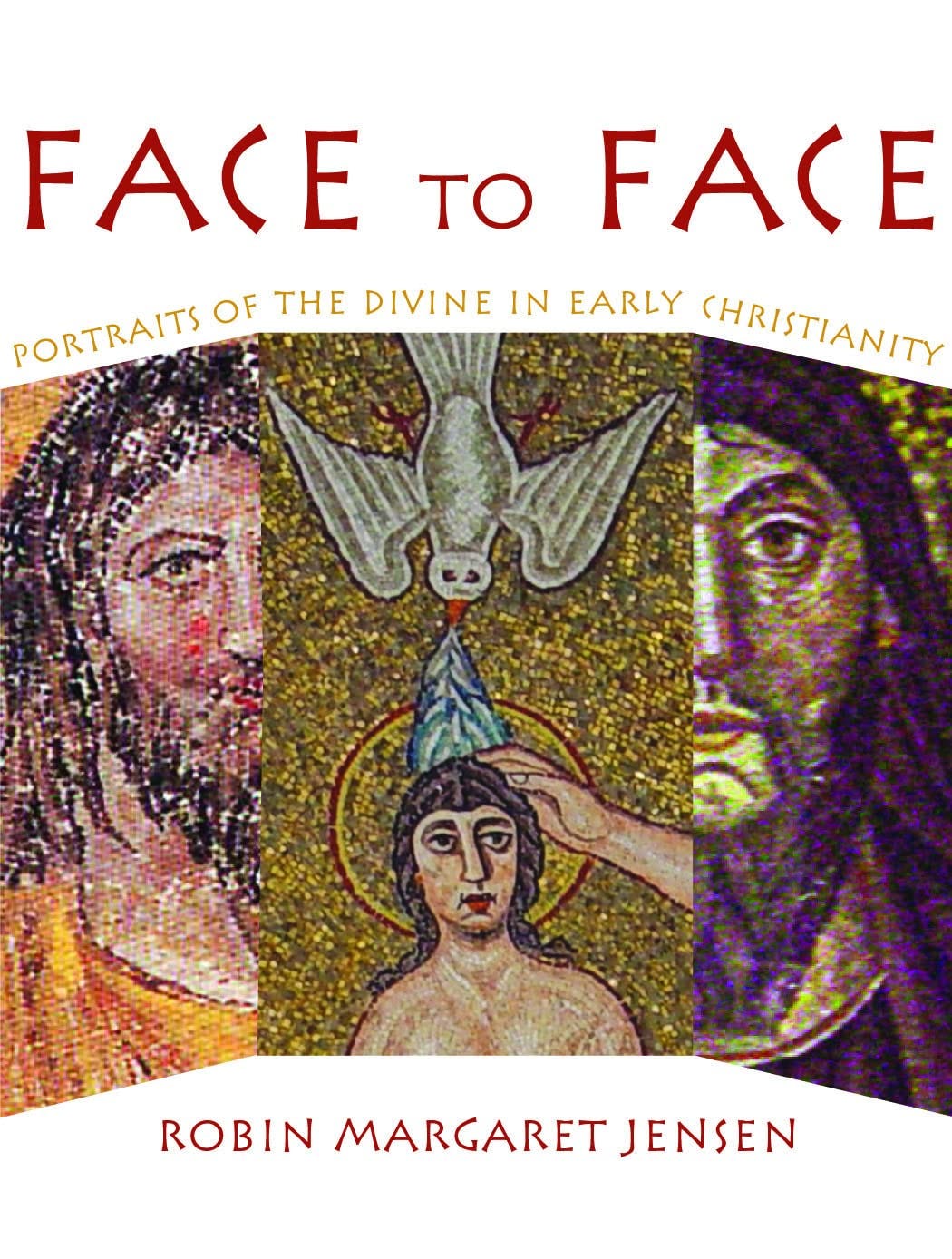
“But just as the tradition of honoring and even venerating saints by means of their portraits was being established, it was also being criticized (additional evidence that it was actually occurring).”18
Internal criticism of a practice in a primary source is positive evidence of the practice occurring contemporaneously. This is basic, standard 21st century historiography. Both Jensen and Truglia, at least on this point, agree with each other in contrast to Ortlund.
February-March 2024 - A 5th century Outlier
In case Dr. Robin Jensen has not been clear enough in the previous two decades of her writing and speaking career that she believes Christian image veneration originated in the fourth century, she took part in an interview for Five Books for Catholics (FBC) in February of 2024 where she explicitly lays this out.19
Jensen: “The development of the portrait at the end of the fourth century emerges at a time when pagan cultic practices have gone—or are going away—and are no longer in any way threatening, I think, to Christians. They start to develop an idea that you could actually pray to an image, or what the image depicts. This is clearly happening at the end of the fourth century, to me, and into the fifth century. So I think it’s a change of practices that has a lot to do with liturgy, devotional practices at the time. It may have emerged and developed because Christians are no longer so worried about falling into what I would call mistakenly venerating the wrong kind of thing or mistakenly venerating the wrong image of God. So yeah.”
FBC: “And is this the subject you’ve covered in your last book, From Idols to Icons?”
Jensen: “Yeah, that’s exactly right.”
14:49-15:56
This was said shortly before Dr. Ortlund was apparently reading Idols to Icons. In a March 2024 X thread, he had a discussion with a user about Jensen’s icon veneration dating and claimed the fifth chapter of Idols to Icons “explicitly identifies the 5th century” and called it an “outlier view… because it is so early.” Here are the most relevant parts of the thread.

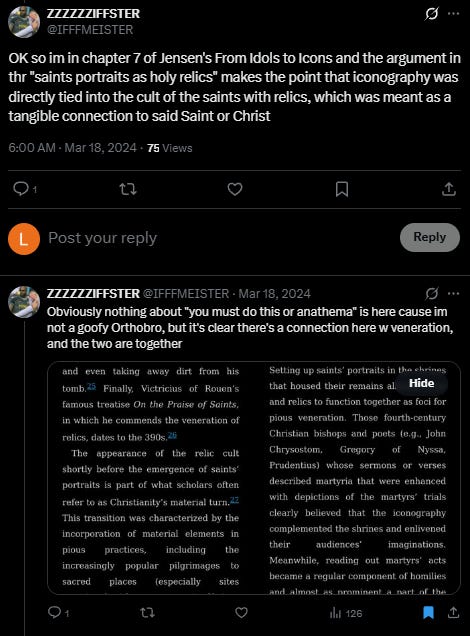
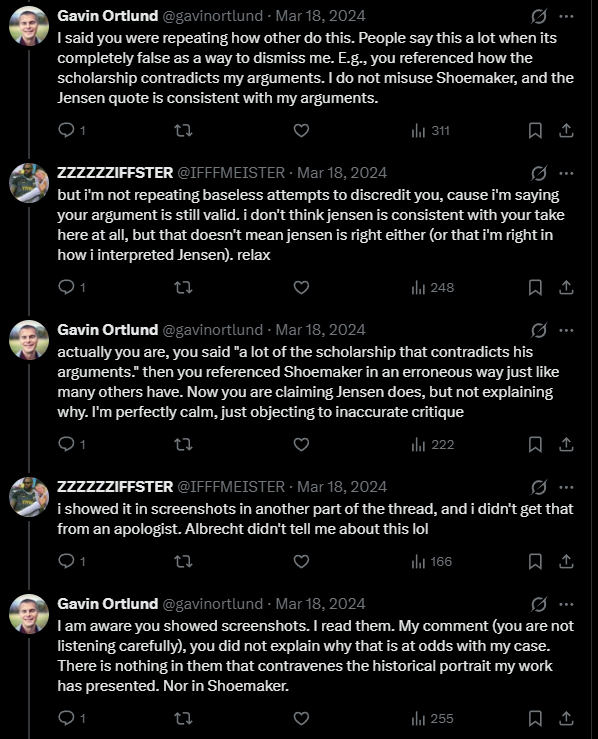
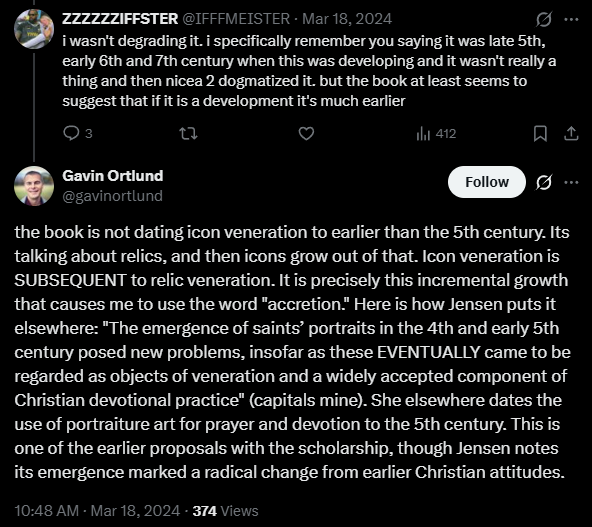
Here, Ortlund explicitly says that Jensen’s Idols to Icons was dating icon veneration no earlier than the fifth century, in stark contrast to what Jensen herself was saying a month earlier. Another user points this out here, citing chapter five of Idols to Icons as support:
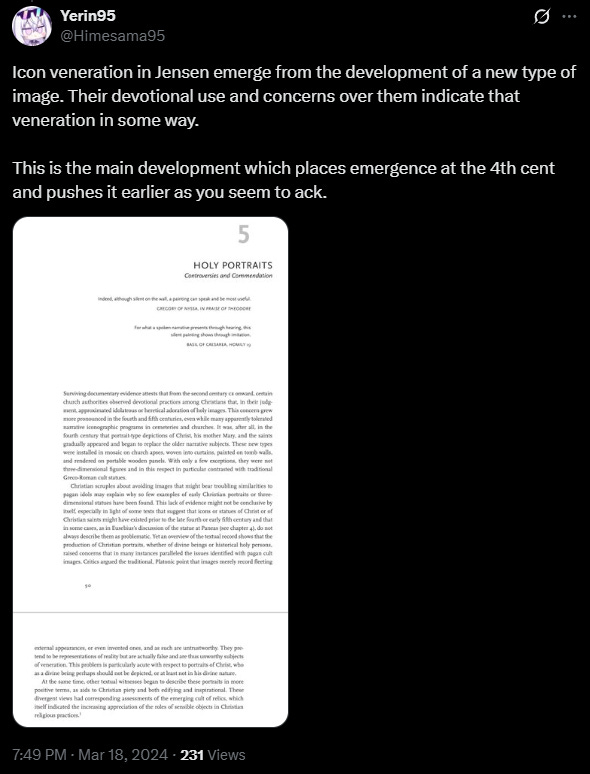
The user was then asked to continue reading further into chapter five of Idols to Icons. Interestingly enough, he makes a more specific claim that the 5th century saw the emergence of “venerative practices related to icons.”
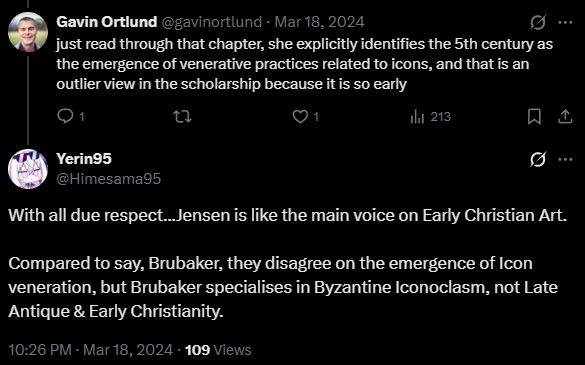
The initial X post that roots this conversation can be found here:


Screenshots taken on March 21st, 2026.
First, if you go to Chapter 5 of Idols to Icons, go back three pages, we see this citation that I referenced above from Chapter 4:
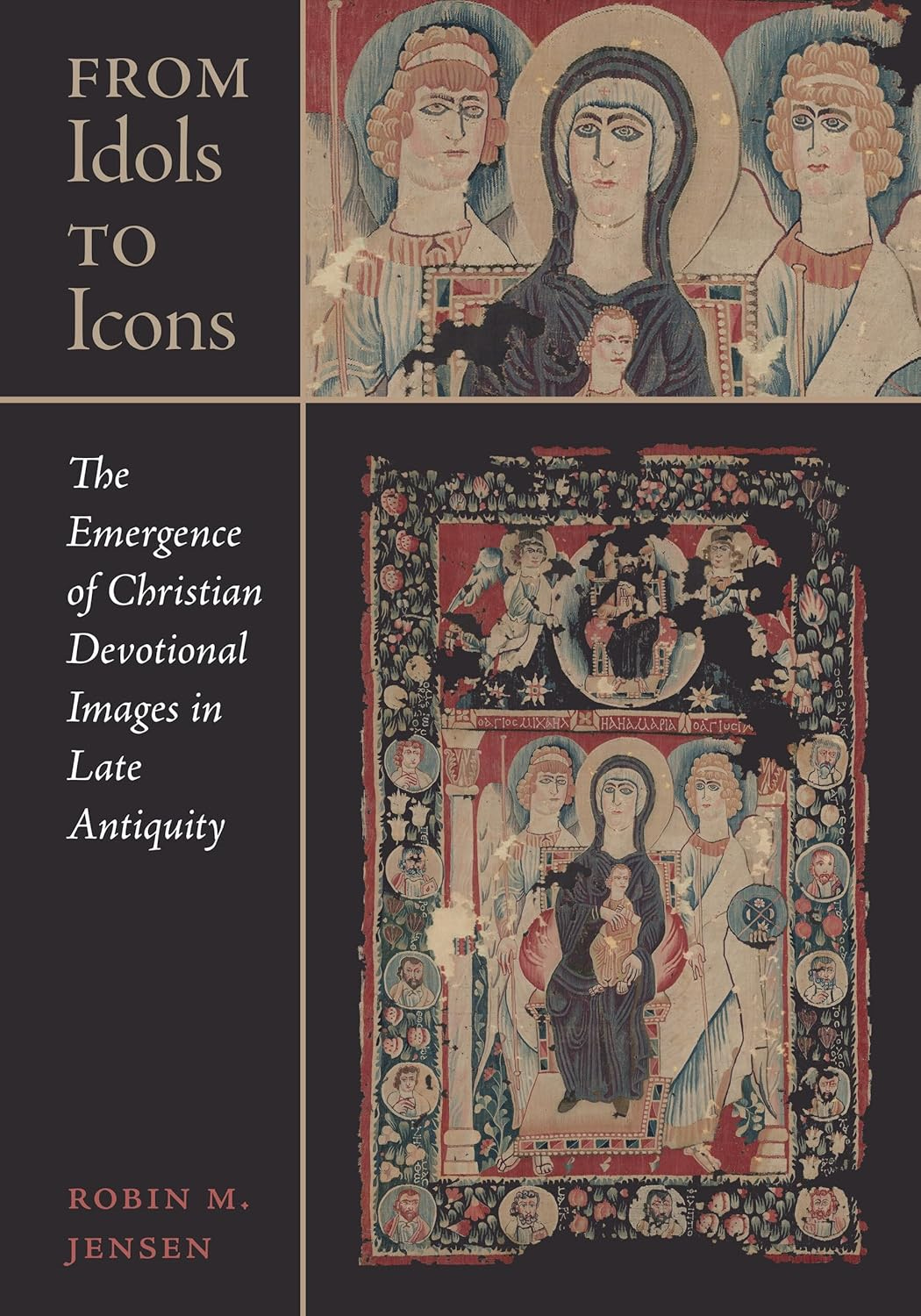
“Some historians have argued that prior to the eighth century, any portraits of Christ or the saints were merely commemorative images or votive offerings rather than objects of veneration and that no evidence supports a Christian cult of images earlier than the seventh century. This argument is partly based on the lack of recorded miracles attributed to icons or beliefs in their intercessory powers in the preiconoclastic period. This leads to the judgment that Christians did not perceive any direct links between the image and the model—that is, they did not have a theology of the image that understood a saint’s portrait as not just a likeness but actually a vehicle for directing prayers or offerings to the one it portrays. Yet the evolution, beginning in the late fourth or early fifth century, away from dominantly narrative images to more frontal, nonnarrative portraits of the saints and Christ, especially but not exclusively in church apses, suggests that viewers were also developing new ways of engaging figurative artworks, which would have included regarding them as focal points of both communal and private prayer.”20
She is explicitly challenging the 6th-7th century consensus. Further down on page 89, She says
“The placement of holy portraits in saints’ shrines, in churches, and even on home altars certainly indicates that these were objects of some type of cultic behavior, if not necessarily one that was widely practiced or approved by church authorities. The next chapter will show that certain church authorities did express their concerns about the pious attentions such images appear to have received from members of their flocks. However, some fifth- and sixth-century writings from other church authorities indicate approval of pictorial depictions of saints, biblical heroes, and Christ and even suggest guarded approval—if not yet a fully developed defense—of their veneration. At the very least, the critiques now aimed at Christian rather than pagan images, along with the strategies that tried to cast them as essentially benign, reveal that they had begun to play a new role in Christian devotional practice.”21
So just before Chapter 5, Jensen is affirming that the production of nonnarrative portraiture and its placement in churches indicate their use as focal points of prayer. This is icon veneration, and Jensen says it’s happening in the fourth century.
Now, Chapter 5 says that:
“While John [Chrysostom] asserted that images of Meletius consoled those who grieved their lost shepherd, according to Gregory of Nyssa’s eulogy for the bishop, given five years earlier (at the time of Meletius’s death), the production of saints’ portraits has an additional purpose. Gregory [4th century] assured his audience that as a saint, Meletius had the power to intercede with Christ for them from his place in heaven and that gazing at his portrait would help viewers sense his presence as they prayed to him for aid. Both of these witnesses evidently believed that the saint’s portrait had spiritual and devotional functions.”22
And here’s one more quote from Chapter 5 in the conclusion.
“Although they are also two-dimensional, portraits of Christ and the saints are categorically different from the earlier narrative images in Christian art, which mainly drew upon Bible stories. Even those portraits that might have been embedded in narrative scenes, like the paintings described by Basil, Asterius, and Prudentius [all fourth century figures], prompted viewers to engage them prayerfully. In this face-to-face encounter, as it were, the images became vehicles for offering veneration to their models.”23
Narrowing the target down to “venerative practices related to icons” is unhelpful here. Again, Ortlund has misread Jensen and attributed a fifth century date to her opinions on the emergence of image veneration. Up to this point, he had been misciting her for over a year. He read Jensen’s 2018 “Aniconism in the Early Centuries of Christianity”, her 2021 “Figural Images” article, and presumably her 2022 Idols to Icons book. All three of these sources espouse a late-fourth-century viewpoint.
May 20th, 2024 - Response to Garten/Sims
Posted shortly prior to “Icon Veneration is STILL an Accretion”. Accessed April 18th, 2026
Then comes the most glaring misattribution. In May 2024, Ortlund responds to Seraphim Hamilton and Michael Garten’s video series. In his section on Tertullian, Ortlund says:24
“Tertullian—Tertullian, almost everybody admits, is thunderingly aniconic. He’s often put up there with Clement as on the extreme end of that. Here’s how Robin Jensen classifies them—you can pause and read this quote if you’d like to.
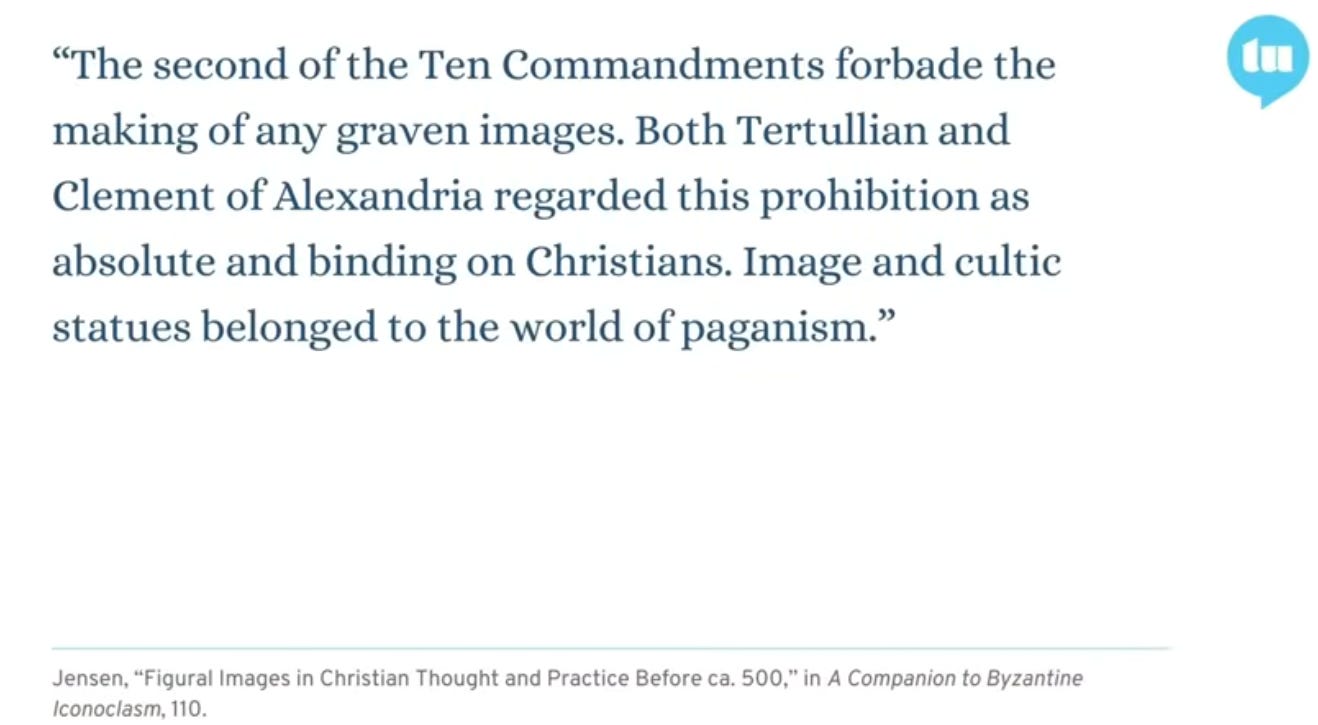
Basically, they both appealed to the Second Commandment and said we cannot use images in worship.”
1:04:50 – 1:05:11
In order to understand this citation error, we need to read the opening pages of Jensen’s 2021 “Figural Images” article. Starting from the second paragraph:
One of the earliest scholars to address the Christian “image question” was Hugo Koch, a German Catholic church historian and a follower of Adolf von Harnack. Writing in the early 20th- century, Koch was convinced that the lack of surviving artifacts demonstrated that ancient Christians were utterly opposed to figural imagery because they scrupulously observed the biblical injunctions against graven images. Koch’s perspective was widely shared in subsequent decades. Theologian Edwyn Bevan, who delivered the Gifford Lectures in Edinburgh in the 1930s (and published them in 1940), acknowledged his debt to Koch, asserting Christians only began producing visual art once they became separated from their Jewish origins and more fully assimilated into a pagan cultural context. Thirty years later, Henry Chadwick, in his brief history of early Christianity stated: “The second of the Ten Commandments forbade the making of any graven images. Both Tertullian and Clement of Alexandria regarded this prohibition as absolute and binding on Christians. Image and cultic statues belonged to the world of paganism.” Chadwick’s statement was echoed by art historian Robert Grigg ten years later, in the opening two lines of an essay which bluntly stated: “It is well known that the spokesmen for the early Christian church were hostile to religious images. They regarded the Old Testament prohibition against images (Exodus 20:4; Deuteronomy 5:8) as binding upon Christians.”25
The problem with Ortlund’s citation is that Jensen did not say this. It is not a quote from Jensen. It is a quote from Henry Chadwick. She very clearly attributed the quote to Chadwick.
Now, we need to read further. The next two paragraphs summarize this hostility consensus with more names and quotes: Ernst Kitzinger, Norman Baynes, James Breckenridge, and Hans Belting. In total, all of these scholars assumed that Christians were literal, strict adherents to the Second Commandment and rejected all art. This should sound familiar to readers of Part 1 of this series.
The seventh paragraph, on page 112, starts a new line of thought:
"During the last decades of the 20th century, scholars began to challenge these judgements.”26
What follows are mentions of Mary Charles Murray and Paul Corby Finney and how they began overturning the hostility theory which was summarized by the above scholars (including Henry Chadwick).
Two paragraphs later, on page 113, Jensen continues this line of thought:
Soon more scholars joined in to offer alternative explanations for the apparent late emergence of Christian material culture, some citing the gradual attainment of economic and social stability, others questioning whether the categories of “Christian” and “pagan” were even applicable (or even appropriate) to material culture in the early centuries.[19] This next wave of scholarly analysis was, thus, far less theological or even ritually-focused in its approach.27
Footnote 19 references the scholars that joined in to oppose the hostility theory:

Yes. Robin Jensen cited herself as an opposing voice to the hostility theory proposed by 20th century individuals as Henry Chadwick.
Furthermore, Jensen gives a summary of Tertullian in this article. However, it is a passage too long for Substack. Thankfully, Mike Humphreys in his introduction to A Companion to Byzantine Iconoclasm summarizes Jensen’s thoughts on Tertullian well. Ortlund should know this because he’s also cited from this introduction:
Therefore, as Jensen argues, when we approach Christian texts from the 2nd and 3rd centuries we must be careful not to over-interpret their strident anti-idolatry message as a critique of Christian images. Rather, the concerns of men like Justin Martyr, Tertullian, and Clement of Alexandria were primarily to criticize the making and venerating of images of the traditional Greco-Roman deities.28
Even Humphreys acknowledges that Jensen is arguing for the “…rather convenient evasive maneuver”.29
It is true that Tertullian goes farther than his contemporaries in setting boundaries around the pagan idolatry of his day. He does not even want image artificers in his churches. But again, what is Tertullian’s target? The pagan use of pagan images.
Not only did Ortlund attribute a statement to Jensen that she never said, he attributed a statement to Jensen that she fundamentally disagrees with and explicitly challenged in the same article. Ortlund mistakenly inverted Jensen’s position and then used her as a mouthpiece for the very position she was challenging in her own article.
Later in August of 2024, Ortlund released his book What It Means to Be Protestant. In this, he maintains most of his citations of Jensen from the 2023 “Icon Veneration is CLEARLY an Accretion!” video. As was said earlier, Ortlund’s thesis was already falsified by his own source material a year before publication. He had the chance to read and reread Jensen to ensure whether or not citing her was favorable to his thesis. Unfortunately, many of his miscitations carried over into a book that was eventually awarded Christianity Today’s 2024 Book of the Year.30 Dr. Gavin Ortlund’s videos and book were the top-level Protestant polemics against icon veneration throughout the early- to mid-2020s.
Eventually, he began to be made aware of these problems.
March 7th, 2025 - Hamilton/Sims Pushback

In May 2025, Seraphim Hamilton and Dave Sims released a video critiquing Ortlund’s icon polemics. There are a series of citations that they alleged contained ellipsis errors and textual truncations. The critique relevant to this article is their assertion that Jensen affirms a fourth century rise to icon veneration alongside the rise of portraiture art. They were correct.
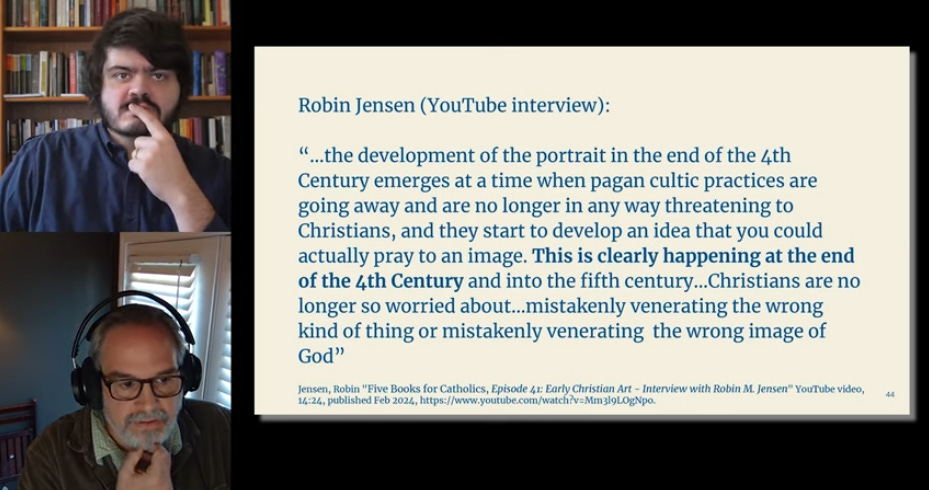
See fn 31. Accessed April 9th, 2026.
Ortlund commented under their video. Eight comments deep into a conversation between him and Sims, Ortlund conceded the fourth-century date saying that:31
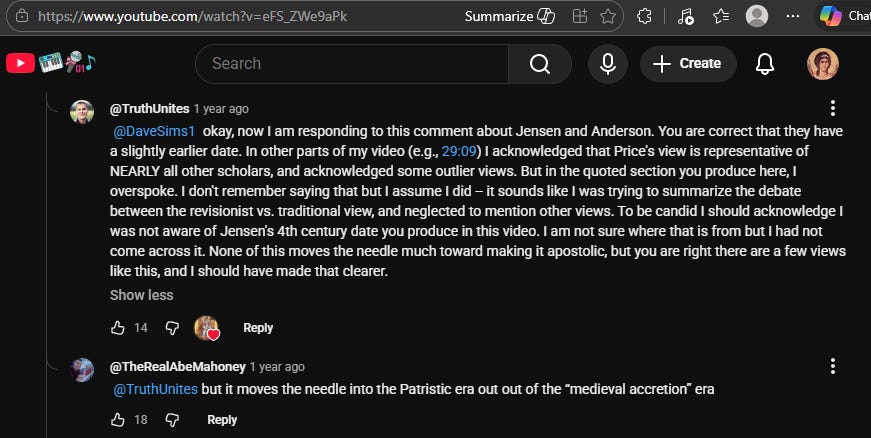
“In other parts of my video…I acknowledged that Price's view is representative of NEARLY all other scholars, and acknowledged some outlier views. But in the quoted section you produce here, I overspoke. I don't remember saying that but I assume I did -- it sounds like I was trying to summarize the debate between the revisionist vs. traditional view, and neglected to mention other views. To be candid I acknowledge was not aware of Jensen’s 4th century date you produce in this video. I am not sure where that is from but I had not come across it. None of this moves the needle much toward making it apostolic, but you are right there are a few views like this, and I should have made that clearer.”
Accessed April 9th, 2026
“I had not come across it”? After having publicly cited or read Jensen’s 2017 “Aniconism in the First Centuries of Christianity”, her 2021 Brill Article “Figural Images in Early Christian Thought and Practice”, and 2022 book Idols to Icons, Ortlund received the impression that Jensen supported a fifth-century origin date for icon veneration.
This is difficult to reconcile with the public record. A fourth century origin date has been Robin Jensen’s explicit position for decades. She annotated this in nearly every single book, article, and public speaking engagement she has on record. Ortlund has effectively misunderstood the most basic positions of Dr. Jensen for over two years.
A lapse like this would normally prompt a public clarification in a high-visibility manner. As of the publishing of this article, he has not done so. Instead, his non-disclosure has been justified by saying how he noted earlier that there were outliers to his sixth through seventh century thesis.
When does he talk about outliers?
Ortlund’s Statements on Outlier Positions
Up until March 7th, 2025, there were only three instances where any hint of outliers to the sixth to seventh century consensus were annotated. I will document them in chronological order:
“…for those who want to say Gavin you’re misrepresenting the scholarship I would like to ask if I am being misleading with the data then the entire scholarship on this point is being misleading on the data or at least the mainstream bulk of it maybe there’s an obscure book here or there um in fact what I did in my opening video is just work through the data points that are the standard front and center issues in the literature if you read Robin Jensen he’s [sic] got another article and then a contribution to the brill book the topics he [sic] goes through are almost exactly parallel with the ones I go through so I’m not trying to like consciously pass over something in no way.”
In this case, he annotates that any form of outlier position could be found in “an obscure book here or there”, but not in A Companion to Byzantine Iconoclasm.
March 18th, 2024:
The second time, a year later, he mentions in X posts that received less than 400 views (as of 21MAR2026) in two years, that Jensen is a fifth century outlier in the scholarship.
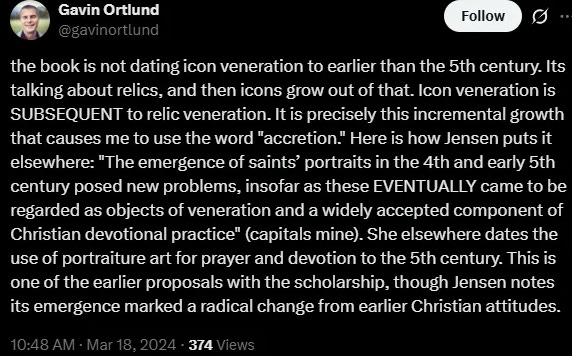

Source:

Screenshots taken March 22nd, 2026
May 20th, 2024:33
The third time, he says that the sixth through seventh century consensus is “representative of what nearly everybody says, except for a few outlier views.”
It’s very clear that the early church did not venerate icons. And in saying that, my position is—I’m not saying anything in my videos on icon veneration. All I am doing is channeling what is basically universally recognized in the scholarship. Father Richard Price—the one who translated it—is entirely representative of the general scholarly position when he says:
‘The iconoclast claim that reverence toward images did not go back to the Golden Age of the fathers, still less to the apostles, would be judged by impartial historians today to be simply correct. The iconophile view of the history of Christian thought and devotion was virtually a denial of history.’
He’s a Roman Catholic scholar who’s honest with the evidence. That position—what Price says [of a 6th - 7th century consensus]—is just representative of what nearly everybody says, except for a few outlier views.”
28:22 - 29:12
However, he has elsewhere not included this qualifier. For example:
November 13th, 2024:34
There is a later instance where he cites Fr. Richard Price again and essentially removes the outlier qualifier:
“Now, Price finds iconoclasm to be kind of an isolated view today, but he’s honest about the historical evidence. He says, quote:
’The iconoclast claim that revered sacred images did not go back to the Golden Age of the fathers, still less to the apostles, would be judged by impartial historians today to be simply correct. The iconophile view of the history of Christian thought and devotion was virtually a denial of history.’
What I am saying in my videos is nothing other than what Price says there. And yet I’ll often find people acting like Gavin Ortlund is making this an issue, ‘Oh, Gavin’s view’ or something. It’s like, it’s not my view; I’m just regurgitating what everybody thinks who looks into this and publishes on it with credentials—in the context of saying that, Price is discussing how it’s either late 7th century or early 7th century, and this is the only debate.”
20:20 - 21:12
One can see this motte-and-bailey situation where some of his videos will have him saying such strong language as “only debate” and “everybody thinks” regarding a sixth to seventh century origin point.
Other videos say that this view is what “nearly everybody says, except for a few outliers.”
One video says that Robin Jensen’s “topics [s]he goes through are almost exactly parallel with the ones I go through”.
And then later he will acknowledge in an X post with less than 400 views that Jensen’s alleged fifth century view of icon veneration is “an outlier view in the scholarship because it is so early.”
Up to his May 2025 concession, no casual viewer could have possibly walked away from this conversation with the impression that Ortlund believes Jensen was an outlier. Neither would they have walked away with the idea that Jensen affirms a late fourth-century origin point for icon veneration. And when he has the opportunity to publicly correct the record and maintain transparency about Jensen’s fourth century date, he fails to do so, such as this example from September 17th, 2025:35

To this day, I’ll find Eastern Orthodox people online saying that I’m a liar because I’ve been corrected about icon veneration but I’m still making the same argument. And I don’t always even know what video they’re talking about specifically. Other times they’ll say so. But a lot of that is unfair. The reality is, what I’m saying in that initial video is completely, standard, uncontroversial, and somewhat assumed in the main—in the big picture of the scholarship. I just give examples of this, but people have never heard it before. So don’t take my word for it. Take Richard Price’s—he’s the one who translated the acts of Nicaea II.
8:30 - 9:08
“In the mainstream — In the big picture of the scholarship”. Now, Dr. Robin Jensen is not mainstream and is not part of the big picture of the scholarship?
This is a stark contrast to him explicitly saying in 2023 that “the topics [Jensen] goes through are almost exactly parallel with the one’s I go through”.
He has objectively been corrected on Jensen’s opinion. And rather than publicly correct the record and apologize for propagating numerous citation errors, he simply says “I don’t always even know what video they’re talking about specifically,” and then covers with a citation from Father Richard Price, neglecting to talk about the pre-sixth century positions of one of the scholars he once favorably cited.
And then, there one more change happened in his approach to using Jensen.
A week after this video about Cleave to Antiquity was published, he had a public conversation with Michael Garten on X. This is a response to a thread from Michael Garten:
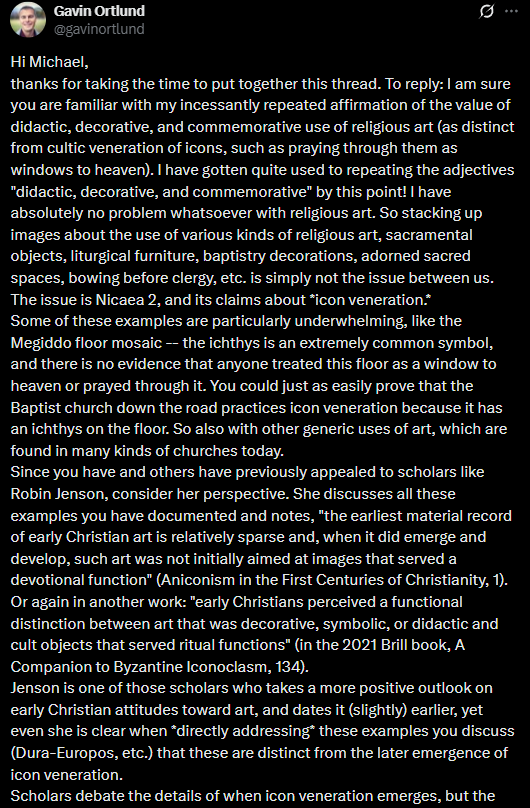
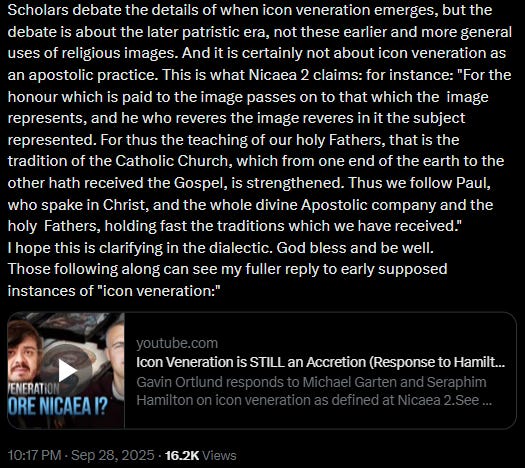
Since you have and others have previously appealed to scholars like Robin Jenson [sic], consider her perspective. She discusses all these examples you have documented and notes, "the earliest material record of early Christian art is relatively sparse and, when it did emerge and develop, such art was not initially aimed at images that served a devotional function" (Aniconism in the First Centuries of Christianity, 1). Or again in another work: "early Christians perceived a functional distinction between art that was decorative, symbolic, or didactic and cult objects that served ritual functions" (in the 2021 Brill book, A Companion to Byzantine Iconoclasm, 134).
Jenson [sic] is one of those scholars who takes a more positive outlook on early Christian attitudes toward art, and dates it (slightly) earlier, yet even she is clear when *directly addressing* these examples you discuss (Dura-Europos, etc.) that these are distinct from the later emergence of icon veneration.
Scholars debate the details of when icon veneration emerges, but the debate is about the later patristic era, not these earlier and more general uses of religious images. And it is certainly not about icon veneration as an apostolic practice.
Source:
Screenshots taken March 22nd, 2026
Note that he will not even say her origin dates. He will not even publicly state Jensen’s fourth century view that he got wrong for over two years. Instead, the tactics changed: It is the Orthodox apologists that have “appealed to Jenson [sic]”.
This will not do.
The first citation of Jensen in this entire conversation was John B. Carpenter’s 2018 Themelios article, published while Ortlund sat on Themelios’ editorial board. Carpenter cited her again in 2021 in the Westminster Theological Journal. Ortlund then began citing her in his viral January 2023 video and his response to Craig Truglia later that month. No Orthodox person online cited Jensen prior to January of 2023.
Making Sense of All of This
Robin Jensen has consistently argued, across two decades of monographs, articles, and public lectures that second and third century Christian apologists were not addressing Christian art at all, that internal debate on the image issue began in the fourth century, and that the veneration of portrait images arose in tandem with the material turn of late fourth century Christianity.
By contrast, Dr. Gavin Ortlund miscited her multiple times in 2023, presenting her as part of the mainstream scholarship which placed the rise of icon veneration in the sixth or seventh century.
In 2024, he was publicly told about Jensen’s fourth-century dating but instead asserted that she was a fifth century outlier, contradicting his previous statement a year earlier that “the topics [Jensen] goes through are almost exactly parallel with the ones I go through”.
Then, in May 2025, when directly shown an interview highlighting Jensen’s opinion, he conceded in a buried YouTube comment section that he “had not come across” her fourth-century dating, despite having multiple sources attesting to this.
Since then, he has offered no update video and no public correction on his icon veneration videos that have now reached hundreds of thousands of viewers. Instead, he has reframed her position as supporting only a “(slightly) earlier” timeline.
When hundreds of thousands of real people are weighing real spiritual, religious, and ecclesial decisions from the influence of videos like Ortlund’s — especially when the content is monetized, repackaged, and sold as an award-winning book — high-profile transparency to the original audience on these numerous lapses is not optional.
Transparency is a moral, ethical obligation. That obligation remains unfulfilled to this day.
However, it is not yet time to call on Dr. Ortlund to fulfill this obligation. I have not finished my critique.
Many will simply say, as Ortlund has, that the fourth-century opinion of one scholar does not prove apostolic icon veneration. That is true. But what if I told you that credible, peer-reviewed continuity views are already on record, and that some of them made their way into the very Companion to Byzantine Iconoclasm that Ortlund has positively cited as “the mainstream bulk” of the current scholarship?
In the next article, we will open this volume and meet these voices.
Robin Margaret Jensen, From Idols to Icons: The Rise of the Devotional Image in Early Christianity (Oakland, California: University of California Press, 2022), 87.
Robin Margaret Jensen, “2022 J.J. Thiessen Lecture 1: The Second Commandment and the Myth of Jewish and Christian Aniconism,” Canadian Mennonite University, YouTube video, October 18, 2022, 1:02:29–1:04:39,
Gavin Ortlund, What It Means to Be Protestant (Zondervan, 2024), 189-190.
Gavin Ortlund, “Icon Veneration is CLEARLY an Accretion!,” Truth Unites, YouTube video, January 5, 2023, 21:39–22:09,
Ortlund, “Icon Veneration is CLEARLY an Accretion!,” YouTube video, 38:32 - 38:55
Ortlund, What It Means to Be Protestant, 189-190
Ortlund, “Icon Veneration is CLEARLY an Accretion!,” YouTube video, 32:49 – 33:31
Robin Margaret Jensen, “Aniconism in the First Centuries of Christianity,” Religion 47, no. 3 (April 21, 2017): 418, https://doi.org/10.1080/0048721x.2017.1316357.
Ortlund, “Icon Veneration is CLEARLY an Accretion!,” YouTube video, 43:42 – 44:36
Saint Augustine, Sermons (306–340A) on the Saints, trans. Edmund Hill, OP, ed. John E. Rotelle, OSA, vol. III/9 of The Works of Saint Augustine: A Translation for the 21st Century (Hyde Park, NY: New City Press, 1994), 140.
Robin M. Jensen, “Figural Images in Christian Thought and Practice before ca. 500,” in A Companion to Byzantine Iconoclasm, ed. Mike Humphreys, Brill’s Companions to the Christian Tradition 99 (Leiden: Brill, 2021), 141.
Ortlund, What It Means to Be Protestant, 189-190
Gavin Ortlund, “Icon Veneration in the Early Church? Response to Craig Truglia,” YouTube, January 19, 2023,
, 5:30 – 6:36.
Ortlund, “Icon Veneration in the Early Church? Response to Craig Truglia,” YouTube video, 15:56 – 17:53
Jensen, “Figural Images in Christian Thought and Practice before ca. 500,” 137
Ortlund, “Icon Veneration in the Early Church? Response to Craig Truglia,” YouTube video, 17:50-18:41
Jensen, “Aniconism in the First Centuries of Christianity,” 418.
Robin Margaret Jensen, Face to Face: Portraits of the Divine in Early Christianity (Minneapolis: Fortress Press, 2005), 185
Five Books for Catholics, “Episode 41: Early Christian Art - Interview with Robin M. Jensen,” YouTube, February 22, 2024,
, 14:49-15:56.
Jensen, From Idols to Icons, 87
Jensen, From Idols to Icons, 89
Jensen, From Idols to Icons, 97
Jensen, From Idols to Icons, 107
Gavin Ortlund, “Icon Veneration Is STILL an Accretion (Response to Hamilton/Garten),” YouTube, May 20, 2024,
, 1:04:50 – 1:05:11.
Jensen, “Figural Images in Christian Thought and Practice before ca. 500,” 109-110.
Jensen, “Figural Images in Christian Thought and Practice before ca. 500,” 112.
Jensen, “Figural Images in Christian Thought and Practice before ca. 500,” 113.
Mike Humphreys, “Introduction: Contexts, Controversies, and Developing Perspectives,” in A Companion to Byzantine Iconoclasm, ed. Mike Humphreys, Brill’s Companions to the Christian Tradition 99 (Leiden: Brill, 2021), 50.
Ortlund, “Icon Veneration is CLEARLY an Accretion!,” YouTube video, 38:32 - 38:55
CT Editors, “Christianity Today’s Book of the Year - Christianity Today,” Christianity Today, December 3, 2024, https://www.christianitytoday.com/2024/12/christianity-today-book-of-the-year-gavin-ortlund-protestant-brad-east-letters-future-saint/.
Seraphim Hamilton, “Where Gavin Ortlund Misuses His Sources,” YouTube, March 7, 2025,
.
Ortlund, “Icon Veneration in the Early Church? Response to Craig Truglia,” YouTube video, 5:59 – 6:38
Ortlund, “Icon Veneration Is STILL an Accretion (Response to Hamilton/Garten),” YouTube Video, 28:22 - 29:12
Gavin Ortlund, “Is Icon Veneration a Big Deal? What Most People Miss,” YouTube, November 13, 2024,
, 20:20 - 21:12.
Gavin Ortlund, “The State of Protestant Apologetics,” YouTube, September 17, 2025,
, 8:30 - 9:08.