An Outright Break with Rome
The Disaster of Reformed Historiography of Art: Part 6, Finale

Iconoclasm, The West, and The Iconophile Franks
In the early eighth century, there were three major powers in Europe: the Byzantines, the Papal States, and the Franks.1 The Iconoclast Controversy is generally accepted to have started around 731 AD with the policies of Byzantine Emperor Leo. This was met by a response in the Latin west. In 731, Pope Gregory III held a synod in Rome which repudiated the iconoclast position that the Byzantines had taken and upheld the production and veneration of Christian images. In 754, the Byzantines under Iconoclast emperor Constantine V convened the Council of Hieria which banned images of Christ, Mary, and the Saints. The Franks’ first formal declaration on images occurred in 767 where a synod was convened in Gentilly with papal representatives present. The Roman Iconophile position was upheld at this synod.
Two years after Gentilly, in 769, another synod was held in Rome, the biggest of the century. Twelve Frankish bishops attended this synod. The image issue was brought up again and the iconophile position was upheld.
These western synods at Gentilly and Rome are most succinctly summarized by Mike Humphreys’ introduction to A Companion to Byzantine Iconoclasm:
In particular, the Franks, the rising power in the West, were increasingly being drawn into the complex political arena of Italy. Both Constantine v and the papacy courted the Carolingian King Pippin, but in the end the Franks decided to double-down on their alliance with Rome. As such in 767 the Franks held a synod at Gentilly, at which images were one of the issues debated, with the Roman position declared correct. Another synod took place in Rome in 769 that condemned Hiereia and declared that images could be venerated.2
To summarize, The Franks signed on with Rome and affirmed the veneration of images in two regional synods 18 years prior to Nicaea II in 787 AD. The Franks affirmed the positions of Nicaea II nearly two decades prior to Nicaea II.
When the Franks first entered the image discussion in the eighth century, they joined hands with Rome in affirming Iconodulia.
The Franks’ Reject Nicaea II
After Nicaea II convened in 787, the Franks received a faulty Latin translation of the acts of Nicaea II. This prompted a reaction from Charlemagne, the king of the Franks, who commissioned bishops, notably the bishop Theodulf to produce a work to refute Nicaea II. In doing so, the Franks adopted a position in between the iconoclasts and the iconophiles, that images were to be neither destroyed nor adored. This work used to be called the Libri Carolini by scholars but is now being called the Opus Caroli. Work on this project began in 790. In the summer of 792, the Franks sent a preliminary document summarizing the thoughts of their developing Opus to Pope Hadrian. The Franks then began preparations to convene a Council in Frankfurt. This preliminary document was not received well by Pope Hadrian who then sent a response letter via the papal envoy that was coming to take part in the Council of Frankfurt. The response letter was undeniably iconophile. The Franks received the response letter by early 794 and found that they were now in disagreement with Rome on image veneration.
“As the winter of 794 progressed, and as preparations for the assembly and council of Frankfurt continued apace, the Franks now knew for certain that Hadrian had rejected their condemnation of II Nicaea and their views on images…Whatever conversations passed between the Franks and the papal legates, the Opus was hastily concluded and silently filed away in the royal archives.”3
Humphreys’ acknowledges this fact that the Opus Caroli was never actually finished. In his introductory chapter to A Companion to Byzantine Iconoclasm, he says that:
“Theodulf never finished his work. A keystone in Carolingian ideology was the alliance with the papacy, and it seems as if the Franks were unaware of Hadrian’s support for Nicaea. Hence they sent an early copy of the Libri Carolini to Hadrian for his comments, and were shocked by his detailed and angry response. To save face, the project was pulled. Instead, at the Council of Frankfurt in 794 Nicaea was condemned for anathematizing those who did not give the same level of adoration to images as they did to the Trinity, something Nicaea does not actually say.”4
In Noble’s chapter of A Companion to Byzantine Iconoclasm, he further clarifies this, saying that:
“…Hadrian’s disappointing Responsum reached the court [of Charlemagne], probably some time in late 793 or early 794 and effectively shut down the project. The Opus Caroli Regis, despite its learning and arguments, was shelved. There is no evidence that it was ever disseminated or that it exerted any influence in later times.”5
Unfortunately, there’s not enough on record to indicate why the Franks changed their position decades later. Noble says in his 2009 book that:
“Clearly the Frankish view of images in the 790s was different from the view to which they had subscribed in 769. It is impossible to say just when the change emerged or became evident.”6
The Council of Frankfurt (794 AD)
There is only one statement from the Council of Frankfurt that addresses the image issue. It was the council’s second canon.
“The question of the recent synod of the Greeks, which was held in Constantinople for the adoration of images, was entered into the discussion; one finds written there that they who do not pay to the images of the saints the same service or adoration as to the divine Trinity are bound by anathema; our above mentioned most holy fathers, utterly rejecting such adoration and service, hate it and agree in condemning it.”7
The problem with canon two of Frankfurt is that the statement that it attributed to Nicaea II was not actually said at Nicaea II. It is a mistranslation. Fr. Richard Price’s translation of Nicaea II preserves the original intent of this statement made by Constantine of Konstanteia on page 229:
“…I accept and embrace with honour the holy and venerable images, and I venerate with worship only the supersubstantial and life-originating Trinity. Those who do not hold and believe accordingly I banish from the holy catholic and apostolic church, subject to an anathema and consign to the portion of those who deny the enfleshed and saving dispensation of Christ our true God.”8
This is clearly different than what was put on record at Frankfurt, so much so that the translation at Frankfurt gives an opposite impression that Nicaea II intended. Nicaea II never tried to say that people should worship images as one worships the Trinity.
Something else worth mentioning is the phrasing of the Frankfurt canon’s last few words, “…hate it and agree in condemning it”. Noble has an extended discussion of the Latin phrasing on page 171 of his book. In short, it is not clear what is being condemned. Is Frankfurt condemning the Nicaea II as a whole, or are they condemning just the mistranslated statement that was referenced? It is an interesting question without a clear answer. Noble has the impression that this ambiguity was intentional on the part of the Franks:
[The Franks] themselves rejected Nicaea and refused to let it be called “seventh” or “universal”. But they did not go so far as to put this rejection on the record at Frankfurt in the presence of papal legates. At least they did not do so if one gives a minimalist reading to the bizarre phrasing of the last part of canon two. Given that some of the best minds of the Frankish world had been addressing the image question and II Nicaea for some four to five years, and given that at least once and maybe twice the image issue was argued out in Charlemagne’s presence, it seems a little off that so much effort produced such modest results at Frankfurt and that the Opus was so quickly forgotten. But there was a need to avoid an outright break with Rome.”9
What we have is the Franks’ private rejection of Nicaea II but an unwillingness to challenge Rome publicly on the subject. Instead, at Frankfurt they presented a misrepresentation of Nicaea II’s acts and rejected this misrepresentation to avoid conflict with Rome. In other words, the Franks dodged the image issue in the presence of the Papal representatives at Frankfurt.
The Franks agreed to disagree on images and kept their opinion off the record to “avoid an outright break with Rome”.10
Addressing Modern Protestant Historiography on Frankfurt
Up to this point I have relied on two sources to build this picture of the Frankish position on Iconoclasm.
-A Companion to Byzantine Iconoclasm edited by Michael Humphreys
-Images, Iconoclasm, and the Carolingians by Thomas Noble
Both of these works have been cited by Dr. Gavin Ortlund to build his penultimate case that:
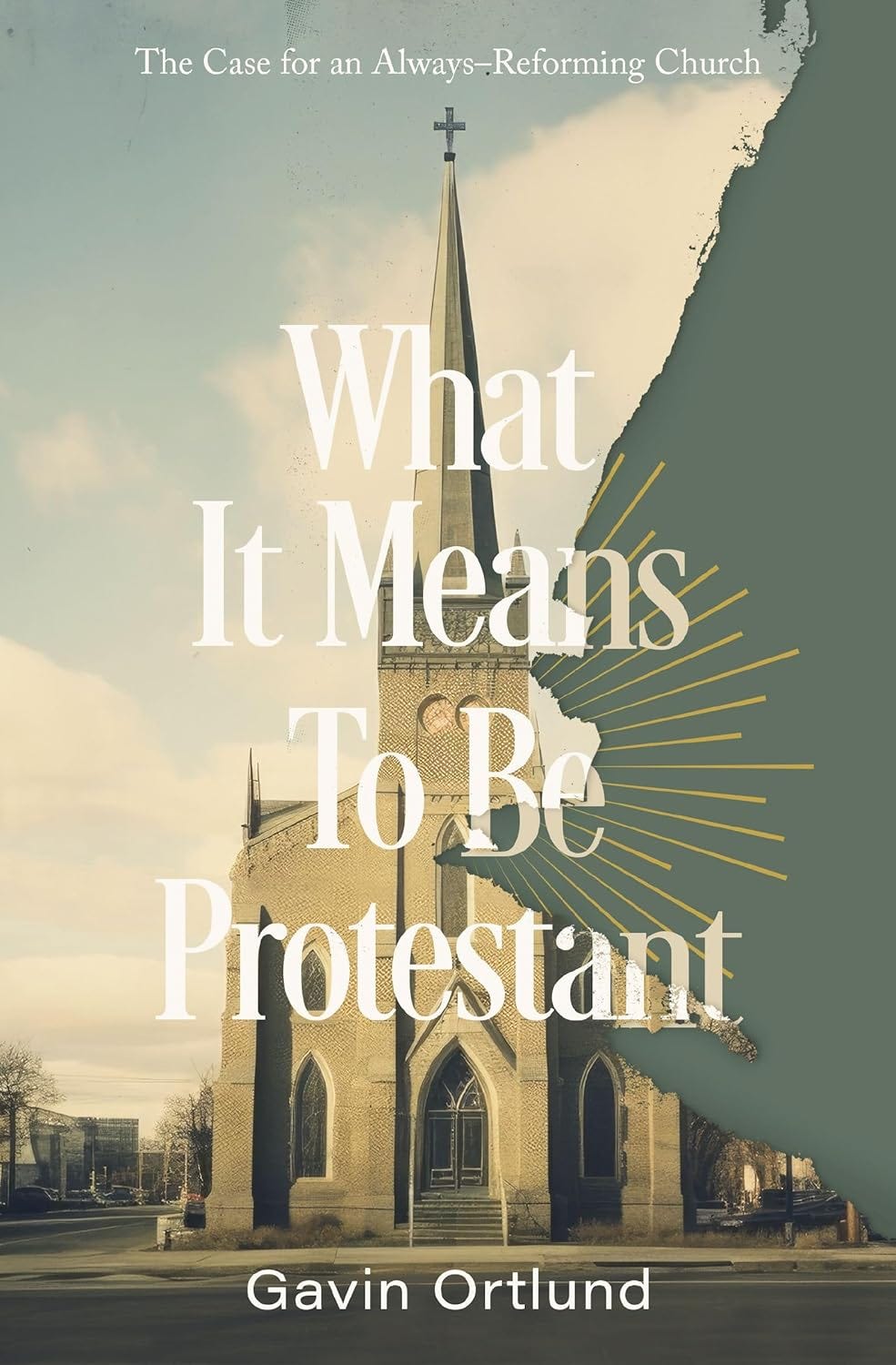
“The Protestant tradition, by contrast, offers us a pathway of meaningful return to the practice and theology of the early church, as well as to that of later contexts like the Council of Frankfurt.”11
Unfortunately, nothing could be further from the truth.
First of all, Dr. Ortlund asserts that Theodulf produced the Opus Caroli around 790.12 This is incorrect. Work began on the Opus in 790, but the document was worked on until around the winter of 794, was not completed, was never published, and its theological positions never entered the record in the Council of Frankfurt. While Ortlund is correct that Noble has shown that the Franks understood the issues at hand and adopted a “principled indifference” on the topic of images, he has also obscured the fact that the Franks did not put this principled indifference on the record at Frankfurt. Noble states this in his 2021 article:
“The Franks held a major council at Frankfurt in 794. Of all the councils, or assemblies, held during Charlemagne’s royal years, Frankfurt was the most important and comprehensive. There were papal legates present at Frankfurt and the Franks pulled their punches so to speak…The key point is that in the only public statement made by the Carolingians about II Nicaea a single, and inaccurate, statement from the massive records of that council was refuted and permitted to stand for the whole. One senses that the Carolingians did not budge on images but also tried to avoid antagonizing [Pope] Hadrian’s envoys.”13
Again, I will highlight that nothing else about images was said at Frankfurt apart from canon two. This is why it is confusing that Dr. Ortlund says this:
“Another concern raised at the Council of Frankfurt was the strained employment of Scripture at Nicaea II.”14
The canons of Frankfurt that we have today do not address any of Nicaea II’s usage of scripture. Again, we have read the only Canon attributable to Frankfurt that dealt with the issue of images. Scripture was not cited in Frankfurt’s canon two.
What follows later in Ortlund’s chapter is arguably one of the worst historiographic errors he has made to date.
“This is not to say that the distinction between worship and veneration is invalid in any context. When a knight bows down to a king, for example, this can be a homage, not idolatry. Bowing before people has many different meanings throughout different cultures and occurs in many places in the Bible. But this is disanalogous to an ongoing liturgical act of veneration directed to nonliving objects. Here is how this distinction was put at the Council of Frankfurt:
“It is one thing to adore a man, that is, to greet him with the duty of a salutation and with the obeisance of politeness and reverence; it is another to adore a picture. For that we should show brotherhood, love, and reverence toward our neighbors we are taught by examples of Scripture, but we are expressly forbidden to adore or to greet images. (Ex. 20:4-5).[88]”15
Bolded here is a statement that Dr. Ortlund attributed to the Council of Frankfurt. The problem is that Frankfurt never said this.
Ortlund attributed a statement to Frankfurt that is not on the council’s records: it is a clear, unambiguous misattribution.
Why did he do this?
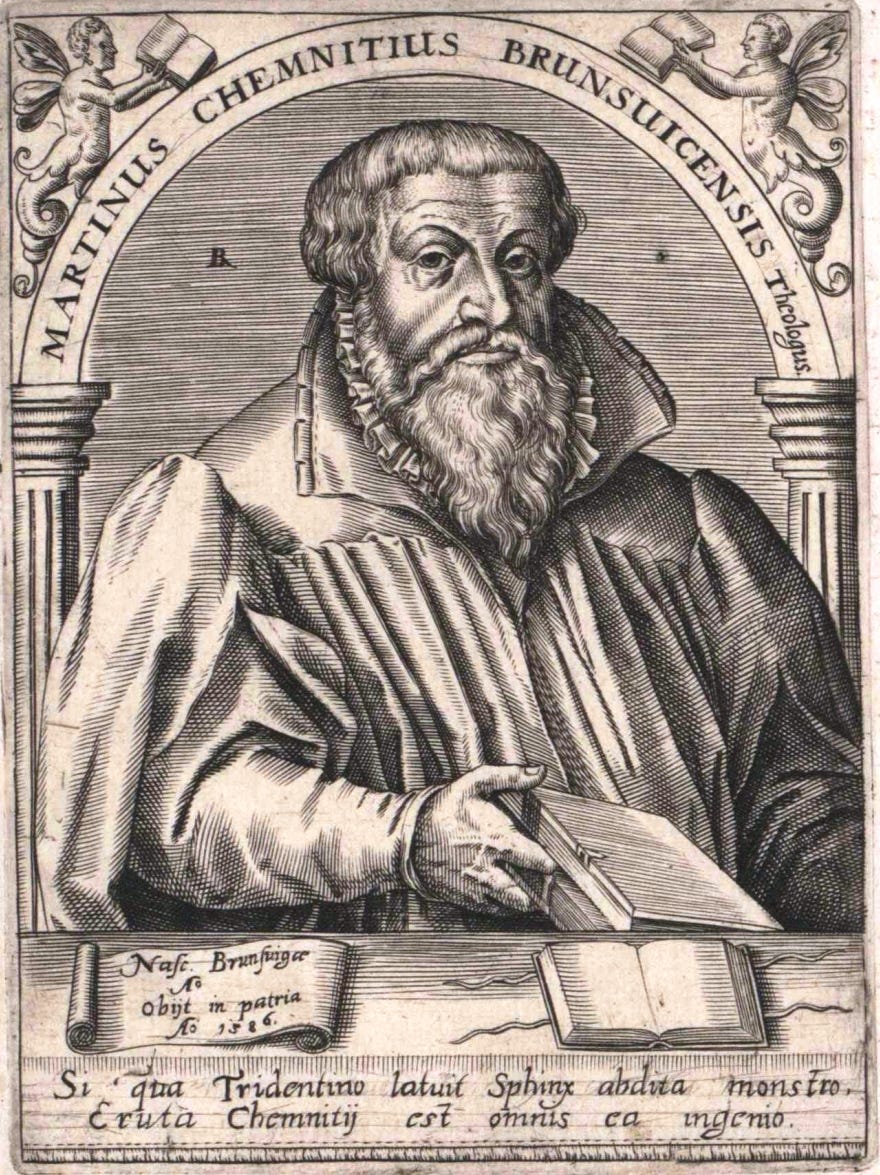
Martin Chemnitz (1522-1586)
In order to understand Dr. Ortlund’s error, we need to look at the accompanying footnote 88.
As cited in Chemnitz, Examination of the Council of Trent, vol. 4, 131.16
The “adore a man” statement is not from Noble’s monograph but from the sixteenth century protestant reformer, Martin Chemnitz. In his day, Chemnitz was known for his four-volume treatise disputing the Roman Catholic Council of Trent. This Examination of the Council of Trent was originally published in Latin but has also been translated into English.
Archive.org has free versions of Chemnitz’s English translation. Volume 4, 2nd Topic, Section 4, Chapter 6, Subsection 2 opens with a discussion on the Council of Frankfurt:
“But a few years ago [which would have been mid-16th century] the books of Charlemagne, which contain the acts of the Frankfort Synod about images, were published in France by Bishop Tilio, on the basis of which the papalist writers are clearly convicted of the crime of fraud.”17
Chemnitz believed that the Opus Caroli contained the acts of the Council of Frankfurt. In other words, every citation that Chemnitz will attribute to Frankfurt is coming from the Opus Caroli, not the council. The quotes certainly reflect the opinions of the Frankish court, but it is not reflective of what was decreed at Frankfurt.
As to whether or not citing the Opus Caroli as part of Frankfurt was valid historiography in the 16th century, I can’t say. However, I can say for certain that no one believes this to be the case in the 21st century. In subsection 4, Chemnitz then says this:
“Tenth. When the pseudosynod [Nicaea II] tries to prove the adoration of images from this: “It is written that Abraham adored the children of Heth, and Moses Jethro,” the Synod of Frankfort responds thus: “It is one thing to adore a man, that is, to greet him with the duty of a salutation and with the obeisance of politeness and reverence; it is another to adore a picture. For that we should show brotherhood, love, and reverence toward our neighbors we are taught by examples of Scripture, but we are expressly forbidden to adore or to greet images (Ex. 20:4-5).”18
Unfortunately the Opus Caroli has not been fully translated from the original Latin into English. However, the Latin Version of Chemnitz's work is also available for free.
When you look at the Latin version of Chemnitz, it turns out that the “adore a man” quote is a truncated quote from the Opus Caroli. Let’s dissect the sentences.19
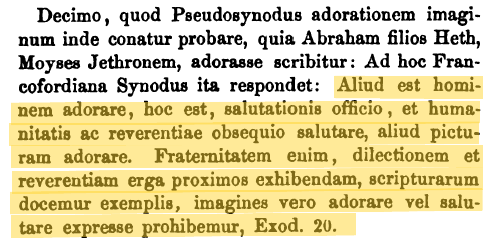
Aliud est hominem adorare, hoc est, salutationis officio, et humanitatis ac reverentiae obsequio salutare, aliud pictoram adorare. Fraternitatem enim, dilectionem et reverentiam erga proximos exhibendam, scripturarum docemur exemplis, imagines vero adorare vel salutare expresse prohibemur.
The Latin of the Opus Caroli is also available online for free.
This phrase that Chemnitz cites as the Council of Frankfurt is actually a shortened paraphrase of a similar quote made in the Opus’ Book I, Chapter Eight:20
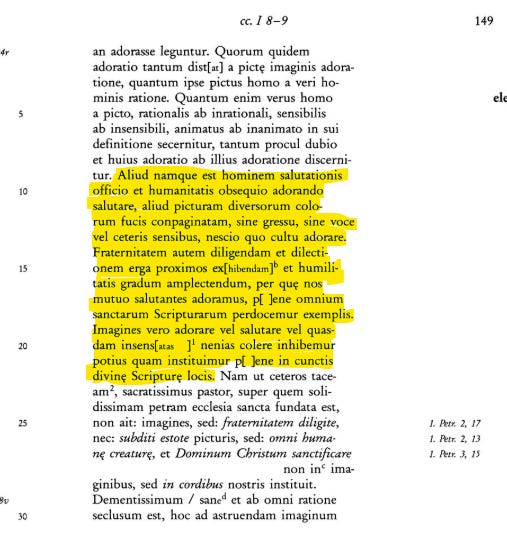
Aliud namque est hominem salutationis officio et humanitatis obsequio adorando salutare, aliud picturam diversorum colorum fucis conpaginatam, sine gressu, sine cove vel ceteris sensibus, nescio quo cultu adorare. Fraternitatem autem diligendam et dilectionem erga proximos exhibendam et humilitatis gradum amplectendum, per que nos mutuo salutantes adoramus, pene omnium sanctarum Scripturarum perdocemur exemplis. Imagines vero adorare vel salutare vel quasdam insensatas nenias colere inhibemur potius quam instituimur pene in cunctis divinae Scripturae locis.
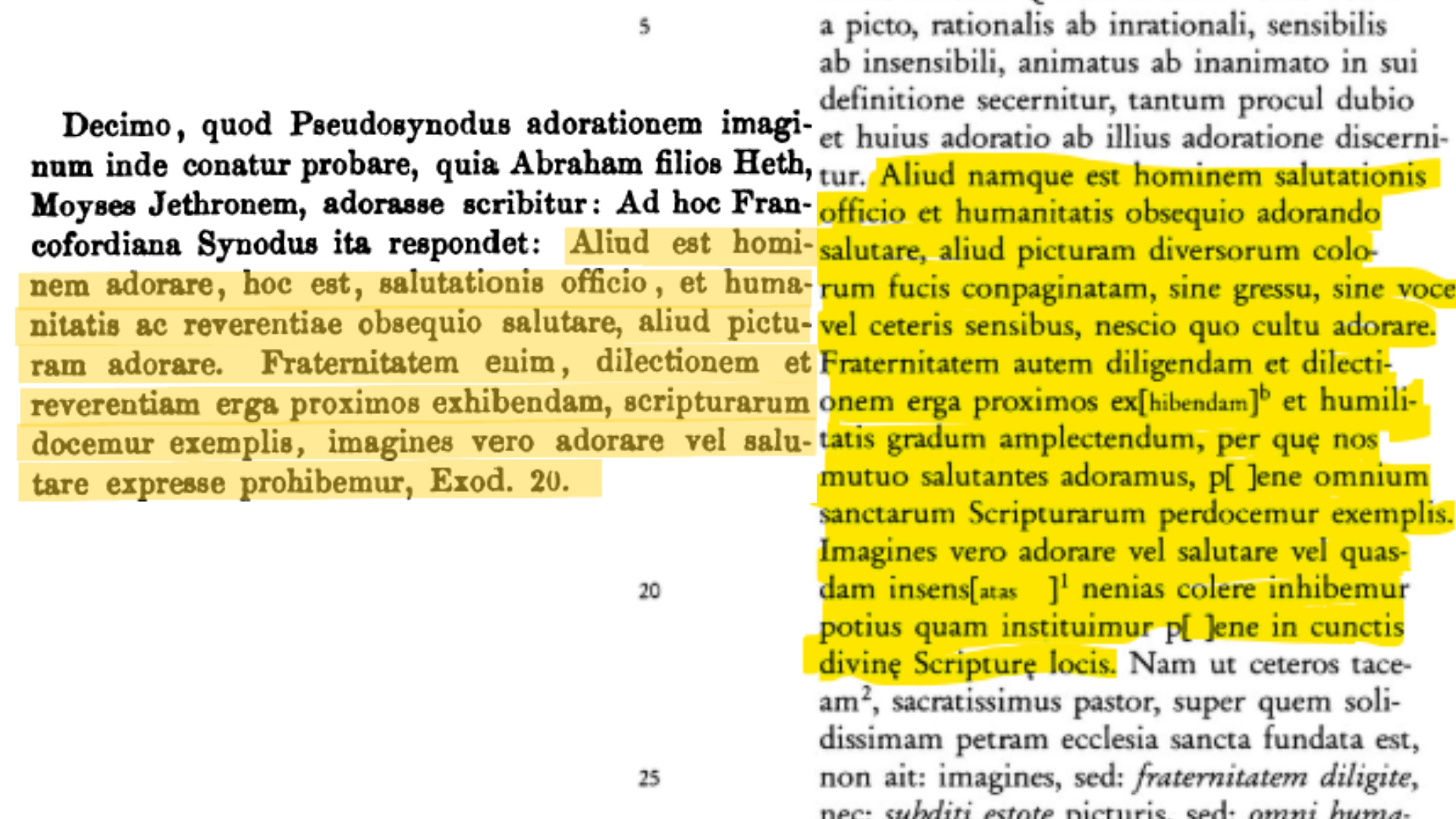
This is not a one-for-one exact citation, but the format and meaning are nearly identical. Where one cannot find this quote is the canons of Frankfurt. I do not fault Chemnitz for shortening this quote into his Examination. I believe this would have been normal for sixteenth century citation work. I also do not fault him for believing that the Opus Caroli contained the acts of the Council of Frankfurt. He may not have known any better at the time.
However, Gavin Ortlund should be faulted for continuing Chemnitz’s error here. This “adore a man” quote is a part of the Opus and was not recorded at the Council of Frankfurt. He has read both Chemnitz and Noble and should have known that this passage was not attributable to Frankfurt. Instead, he has been posting this statement for as long as he has discussed icon veneration online, first in September of 2021:21
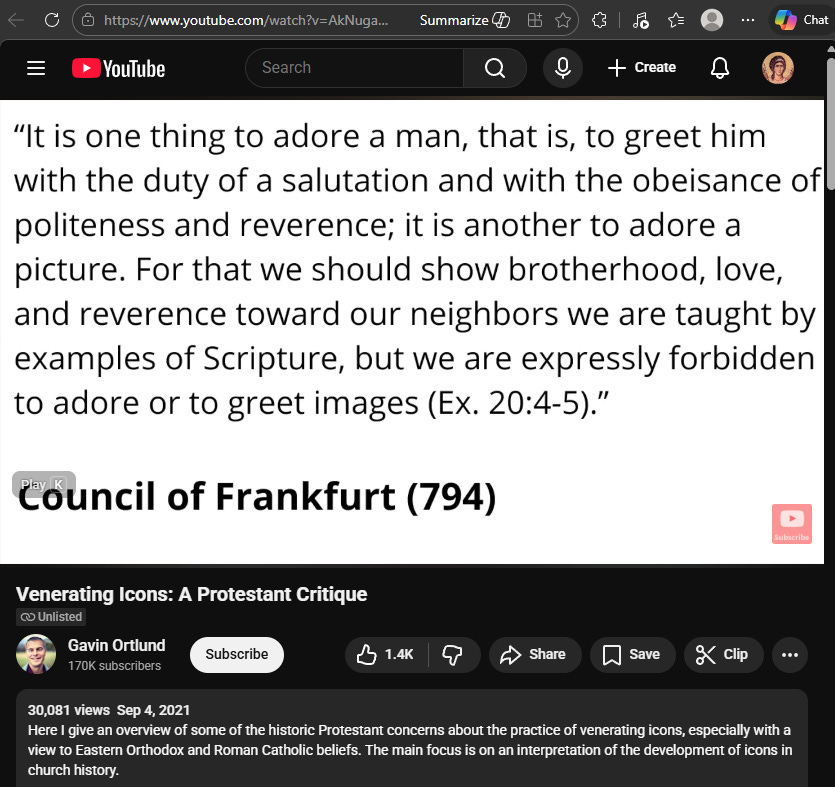
“I don’t think there are any compelling examples of an object being venerated comparable to bowing down to an icon or kissing an icon. I don’t think there are any examples of that in Scripture.
So if that is a legitimate practice, why don’t we ever see that in Holy Scripture?
And just to justify a little bit this distinction between a living object and a non-living object, here’s how the Council of Frankfurt — which I just referenced — puts it:
“It is one thing to adore a man, that is, to greet him with the duty of a salutation and with the obeisance of politeness and reverence. It is another to adore a picture. For that we should show brotherhood, love, and reverence toward our neighbors we are taught by examples of Scripture, but we are expressly forbidden to adore or greet images.”
And then it quotes the Second Commandment. That’s from Frankfurt.”
32:10 - 32:57
He then cited this “adore a man” statement again in January of 2023.22
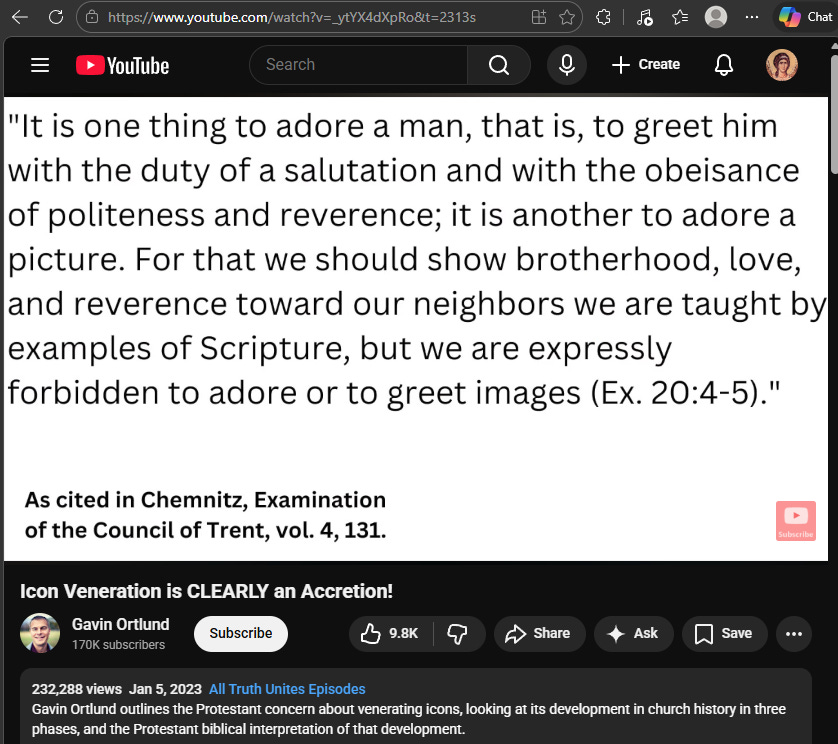
“Now this is not to say that the distinction between worship and veneration — or other forms of respect — has no validity in any context. When a knight bows down to a king, for example, this can be an act of homage, not an act of idolatry. Bowing down to people has a different range of meanings throughout different human cultures, and it occurs in many places in the Bible.
But that is disanalogous to an ongoing liturgical act of veneration directed to non-living objects.
It is one thing to adore a man, that is, to greet him with the duty of a salutation and with the obeisance of politeness and reverence; It is another to adore a picture. For that we should show brotherhood, love, and reverence toward our neighbors we are taught by examples of Scripture, but we are expressly forbidden to adore or greet images” And then they quote the Second Commandment.
And that’s true — you find examples in Holy Scripture of people bowing down to other people, but you never find examples of people bowing down to non-living objects in this kind of liturgical act of reverence.”
1:01:10 - 1:02:22
Finally, as shown above, he cited this statement in his 2024 book What It Means To Be Protestant.
He has repeatedly attributed a statement to the Council of Frankfurt that was never actually said. While it’s true that the Opus Caroli was an accurate summation of the Carolingian position, this position was not formalized at Frankfurt and never circulated outside of the main circle of Charlemagne’s court, until the Reformation, 800 years later. This is a problem for Ortlund and today’s Protestant position because he has settled his opinion on icons around the theology of the council of Frankfurt. Again, this theology is not in Frankfurt’s records. There is no theology of icons that can be derived from Frankfurt alone, which only says the following about images and Nicaea II:
“The question of the recent synod of the Greeks, which was held in Constantinople for the adoration of images, was entered into the discussion; one finds written there that they who do not pay to the images of the saints the same service or adoration as to the divine Trinity are bound by anathema; our above mentioned most holy fathers, utterly rejecting such adoration and service, hate it and agree in condemning it.”23
Ironically, any Catholic or Eastern Orthodox person would agree with the Franks here, if this was what Nicaea II said. Unfortunately, we know today that this quote is not attributable to Nicaea II. According to the most up-to-date scholarship, this misrepresentation was intentional so that Charlemagne could avoid breaking his otherwise sound relations with the Bishop of Rome, Pope Hadrian.
The Franks Were Not Protestant
It is true that even though Frankfurt does not contain a theology of images, the Opus Caroli does. However, if Dr. Ortlund or any Protestant wants to fall back and say that they align with the Opus Caroli, they should be reminded that the Opus was never finished and contains Catholic positions that he would disagree with. Noble notes that the Opus argues in its first book that doctrine should be deferred to the interpretations of the Pope:
“Chapter five [of Opus’s book 1] makes the simple point that Scripture must not be interpreted willfully, must not be subverted to the needs of the moment. There is a tradition of interpretation that must be strictly observed. Chapter six, which was not one of Theodulf’s original ones, sets out the argument that on all difficult, disputed matters Rome must be consulted. Only those writings that have been approved by the popes or that are found in such books as Gelasius’s Decretum are to be consulted. Peter preceded all the apostles, Theodulf says, so the bishop of Rome precedes all others now. Jerome, one of the greatest of the church fathers, did not hesitate to consult Pope Damasus and more recently Pippin [King of the Franks before Charlemagne] eagerly sought Rome’s advice on matters of worship, and after God handed Italy to “us” we have consulted Hadrian on the same problems. In all things the see of Peter must be followed, especially by us who have been given by God the rule of Gaul, Germany, Italy, and the Saxons.”24
Even if it wasn’t Theodulf’s hand that wrote this chapter, as Noble indicates, it is still plain and simple that the Opus, as is, argues for a deference to the Roman Bishop, or Pope, as a prime argument in its writing.
Second of all, Noble notes that the Opus’ opening critique of Nicaea II’s use of scripture was not to mock it as ridiculous, as Chemnitz did, but that they should have used a more spiritualized interpretation that was in line with that of Rome’s:
“In short, Theodulf says that the Bible must be read correctly, that the safest guide to correct reading is the Roman tradition, that passages quoted by the Greeks should be taken spiritually, as the fathers have done, and not literally, and that it is critical to understand what is meant by the image in the first place.”25
Finally, and most importantly, The Opus upholds the holy and consecrated nature of relics, a distinctive that Protestants reject as idolatry.
“Here [in chapter 24] Theodulf argues that some things are made holy by God Himself and some by the consecration of a priest; this repeats what he says earlier about vessels. Images fit into neither category. Relics are holy because they are the bodies, or parts of the bodies, of the saints or else items, like clothing, that saints touched or used.”26
Even Phillip Schaff, the 19th century Protestant historian recognized this point.
“The author of the Caroline books, however, falls into the same inconsistency as the Eastern iconoclasts, by making an exception in favor of the sign of the cross and the relics of saints. The cross is called a banner which puts the enemy to flight, and the honoring of the relics is declared to be a great means of promoting piety, since the saints reign with Christ in heaven, and their bones will be raised to glory; while images are made by men’s hands and return to dust.”27
In short, the Opus Caroli was not a Protestant manifesto. It was a Catholic document written by Catholic bishops who still deferred to the pope and venerated relics.
Can Protestants truly say that they reflect the mindset and praxis of the relic-venerating Franks who deferred to Rome’s authority so much that they ambiguously misrepresented a council they disagreed with in order to prevent an open break with Rome? Clearly, they cannot. Instead, to maintain consistency, the only option that Protestants have is to reject Charlemagne and his subjects as idolaters.
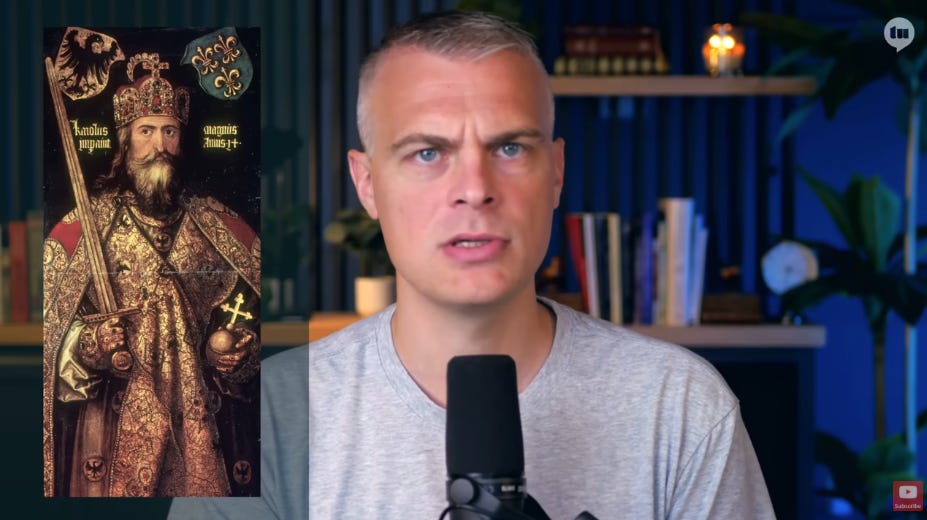
Dr. Gavin Ortlund is Wrong About The Franks
Not only can Dr. Ortlund not stake his Protestant claim of historicity in the Council of Frankfurt, he cannot even appeal to the Opus Caroli. To do so, one has to ignore or omit sections of the Opus to say that Protestants can affirm it.
As we will see, every single statement that Dr. Gavin Ortlund has made about the Council of Frankfurt is untrue at some level. I will document his claims here exhaustively.
January 5th, 2023: Icon Veneration is CLEARLY an Accretion!
“So, the protestant tradition offers us a way to be …deep in history, to live consistently with the practice of the early church as well as that of later contexts like the Council of Frankfurt for example. It also allows us to obey the Second Commandment and there are no anathemas that we are required to adhere to. Therefore, the Protestant position of rejecting Nicaea II is the position that is deep in history…”
1:13:56 – 1:14:23.
No, the Protestant cannot live consistently with the Council of Frankfurt, unless you want to start venerating relics.
May 20th, 2024: Icon Veneration is STILL an Accretion (Response to Hamilton/Garten)
“The more basic problem here is again, the equivocation on the word veneration. Okay, honoring living human beings is not a problem at all, the iconoclasts are fine with that; okay, I’ve quoted from the Council of Frankfurt on that for example, that’s not a problem at all.”
59:24 - 59:41
No, Ortlund never actually cited the Council of Frankfurt. He followed Chemnitz’s mistake in citing the Opus Caroli as if it was Frankfurt.
“These people in these [Catholic/Orthodox] traditions are yoked to anathemas that are actually anathematizing what was the universal Christian practice until at least the last 6th century and probably the late 7th. That is how badly Nicaea II has kind of screwed up Christendom, to put it like that. Infinitely better to go with the Council of Frankfurt in the west and as a Protestant you can do that.”
1:13:23 - 1:13:50
No, as a Protestant, one cannot go with the Council of Frankfurt. It rejected a misrepresentation of Nicaea II and did not produce a theology of images.
“Luther is a very imperfect person but on this point, I think he showed courage because he’s not yielding to pressure. He’s following what is true and he’s saying I stand upon the Word of God but part of that appeal is, look at church history. It’s obvious that sometimes we got it wrong and that applies even to the Ecumenical Councils because frankly, the Council of Frankfurt just is a lot better theology that Nicaea II and a lot less forged documents, a lot less interpolations being jammed into earlier texts and so forth.
So the upshot of all this is, I would invite every person watching this video and those who are wrestling with these ecclesial issues to place your ultimate trust in the Word of God. What the Bishops did at Nicaea II in 787 under the thumb of the cruel Empress Irene, that is not the inspired Words of God. That’s human. God’s at work in the midst of it, but it’s human. It can err. Just as Hieria and Frankfurt and the other councils at that time that are rejecting it and going in the other direction can also err.”
1:15:03 - 1:16:13
Again, the Council of Frankfurt did not produce a theology of images. The Opus Caroli did, but one cannot go with the Opus for the reasons stated above.
Nov 13, 2024: Is Icon Veneration a Big Deal? What Most People Miss
“Something’s really at stake in this; both sides, the Iconoclast side opposing icon veneration, the iconophile side affirming it. Both sides convoke these massive councils with hundreds of Bishops to attempt a definitive judgment one way or the other. In the East, you have the Council of Hieria. In the West, you have the Council of Frankfurt, both of which are affirming iconoclasm which by the way, iconoclasm as Richard Price points out doesn’t mean destroying images, it just means opposing icon veneration”
1:52 - 2:21
This is just an obfuscation of terms. Frankfurt was not affirming iconoclasm in any way. The word iconoclasm etymologically corresponds to the Greek terms, meaning Image-Breakers.
“Let’s put aside this idea that opponents of Nicaea II are anti-art. All you have to do to see that is read through the alternative councils. Read the theology of the Council of Frankfurt. These Western Frankish bishops are very pro-art but they’re very anti-Nicaea II.”
16:01 - 16:20
You cannot read the theology of the Council of Frankfurt because the council did not produce a theology of art. The Franks did produce their own theology of art, sure, but Noble notes that this theology did not make its way into Frankfurt.
“the Council of Nicaea II is just wrong in its claims. And something like the [sic], I would say the Council of Frankfurt even more than Hieria is much better and it doesn’t mean the church died, it just means the church is fallible”
24:15 - 24:27
Better in what way? Frankfurt produced a mistranslation of Nicaea II that misrepresented that council’s intent. Then, this misrepresentation was rejected at Frankfurt. How is that any better than Nicaea II or Hieria?
August 20th, 2024: What It Means To Be Protestant
“In 794, Charlemagne convoked the Council of Frankfurt, which was also strongly critical of Nicaea II and refused to call it an ecumenical council. But the council adopted a more moderate position than Hieria. The essential Western position was that figural art is acceptable for decorative or commemorative purposes, but it should not be worshipped or bowed to; and it ought to be neither destroyed nor mandated.” (Pg. 208)
No, the council did not adopt or formalize a position relative to other councils.
“Another concern raised at the Council of Frankfurt was the strained employment of Scripture at Nicaea II.” (Pg. 209)
Again, no. The Opus addressed the use of scripture relative to images but Frankfurt did not.
“Unfortunately, traditions that consider Nicaea II to represent infallible teaching cannot reform its teaching. It is, by definition, irreformable. The Protestant tradition, by contrast, offers us a pathway of meaningful return to the practice and theology of the early church, as well as to that of later contexts like the Council of Frankfurt.” (Pg. 217)
The Protestant tradition does not allow anyone to return to the Council of Frankfurt because the Franks, the Opus Caroli, and the Council of Frankfurt were not Protestant.
July 22, 2025: These A.I. Videos Raise a Theology Question
“But as I’ve said from the very beginning — in my first video January 2023 about this — I’ve always been clear: the theology of that council is very specific about venerating and praying through icons. It is not about the general religious use of art.
So from my very first video, I’ve always — even though this gets misrepresented a lot — I’ve always said that didactic, decorative, and commemorative uses of art are totally acceptable. That’s not the issue.
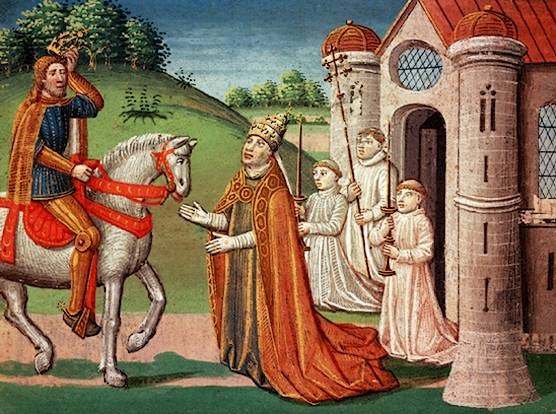
And I’ve always said that a more balanced account is offered by the Council of Frankfurt, which was convoked by Charlemagne, whom you can see on screen here. This was a western council in 794 which rejected both the destruction of images as well as the requirement of their veneration.”
6:59 - 7:45
Again, Frankfurt rejected a misrepresentation of Nicaea II in order to ambiguously avoid an open conflict with the iconophile Roman legates that were present for the council.
A Pathway of Meaningful Return
We have reached the end of the series. Throughout these articles, I have tried to educate the reader by prioritizing a close, forensic portrayal of the secondary literature over my own theological convictions. With the historiographic case now laid bare, I believe I have earned the right to offer some concluding reflections from my perspective as an Eastern Orthodox Christian.
The disaster of the Reformed historiography of art is now complete. It was never a pathway of meaningful return to the early church. Over the last two centuries, Protestant scholars and apologists have repeatedly been proven wrong on a substantive level, forcing inevitable shifts in the narrative. This early twenty-first century iteration represented by Dr. John Carpenter and Dr. Gavin Ortlund is no different.
On the contrary, the claims of the Second Council of Nicaea have continued to be vindicated as history marches onward.
When John Calvin sought to cast the early church as hostile to images for the first 500 years, archaeological evidence of Dura-Europos and the Roman Catacombs later proved him wrong.
When twentieth century scholars carried Calvin’s ideas of an aniconism into Christianity’s first two hundred years, Paul Corby Finney refuted the literalistic renderings of the early church literature that were weaponized to support this hostility theory.
Finally, when early twenty-first century Protestant polemicists revived and modified these claims for the digital age, they misrepresented the scholarship and councils they cited in their efforts to cast early Christianity as opposed to icon veneration, presenting theses that many of their own sources would reject.
This is not the iconophile view of history brought to its knees, as Ortlund, Carpenter, or even Leslie Brubaker would think.28 This is a 1,200-year-long vindication of the fundamental and evergreen claims of an ecumenical council that made the modest but enduring assertion that:
“We preserve without innovation all the traditions of the church that have been laid down for us whether written or unwritten. One of these is reproduction in painted images, as something that is in harmony with the narration of the gospel message for the confirming of the real and in no way phantasmal incarnation of God the Word, and which serves us by conferring the same benefit. For these two things provide indisputable proof of each other and give expression to each other.”29
Archaeological discoveries and advances in the historiographic conversation in recent centuries continue to validate this claim. In stark contrast, Calvin’s claim of a half-millenium-long aniconism and the softer claims of his spiritual descendants continue to fall from relevance. What I said in the conclusion of my first article rings even truer now than when I first typed it.
How many more times must the Reformed historiography of art be falsified before we are allowed to ask whether the Protestant Reformation and its descendants ever truly grasped the praxis of the early church they have continually claimed to be reforming towards?
I still have yet to be convinced that they ever did.
Much of the history of the Franks as stated here is derived from Thomas F X Noble, Images, Iconoclasm, and the Carolingians (University Of Pennsylvania Press, 2009). The contents of this book are largely restated by Mike Humphreys, “Introduction: Contexts, Controversies, and Developing Perspectives,” in A Companion to Byzantine Iconoclasm, ed. Mike Humphreys, Brill’s Companions to the Christian Tradition 99 (Leiden: Brill, 2021), 98-102 and Thomas F. X. Noble, “Iconoclasm, Images, and the West,” in A Companion to Byzantine Iconoclasm, ed. Mike Humphreys, Brill’s Companions to the Christian Tradition 99 (Leiden: Brill, 2021), 538-570.
Humphreys, “Introduction: Contexts, Controversies, and Developing Perspectives,” 99-100.
Noble, Images, Iconoclasm, and the Carolingians, 170
Humphreys, “Introduction: Contexts, Controversies, and Developing Perspectives,” 101
Noble, “Iconoclasm, Images, and the West,” 553
Noble, Images, Iconoclasm, and the Carolingians, 206
Noble, Images, Iconoclasm, and the Carolingians, 170
Richard Price, The Acts of the Second Council of Nicaea (787) 2, Sessions V-VII, Letters from the Council, Encomium, Canons, Tarasios, Letters, Greek Appendix, Appendices, Bibliography, Map, Indices (Liverpool Liverpool University Press, 2018), 229.
Noble, Images, Iconoclasm, and the Carolingians, 172
Noble, Images, Iconoclasm, and the Carolingians, 172
Gavin Ortlund, What It Means to Be Protestant (Zondervan, 2024), 218
“Around 790, Theodulf of Orleans produced his Opus Caroli…”, Ortlund, What It Means to Be Protestant, 209
Noble, “Iconoclasm, Images, and the West,” 554-555
Ortlund, What It Means to Be Protestant, 209
Ortlund, What It Means to Be Protestant, 215
Ortlund, What It Means to Be Protestant, 261

Ann Freeman and Paul Meyvaert, Opus Caroli Regis Contra Synodum (Libri Carolini) (BoD – Books on Demand, 1998), 149.
Gavin Ortlund, “Venerating Icons: A Protestant Critique,” YouTube, September 4, 2021,
, 32:10 - 32:57.
Gavin Ortlund, “Icon Veneration is CLEARLY An Accretion!,” YouTube, January 5, 2023,
, 1:01:10 - 1:02:22.
Noble, Images, Iconoclasm, and the Carolingians, 170.
Noble, Images, Iconoclasm, and the Carolingians, 186.
Noble, Images, Iconoclasm, and the Carolingians, 187.
Noble, Images, Iconoclasm, and the Carolingians, 200.
Schaff, Philip. History of the Christian Church - From The 1st To The 20th Century (All 8 Volumes) (Kindle Locations 60239-60242). www.DelmarvaPublications.com. Kindle Edition.
While the personal biases and convictions of Leslie Brubaker have not been disclosed publicly, the final sentence of her revisionist monograph should give us pause: “We hope that, if we have achieved nothing else, we can say convincingly that the iconophile version of the history of eighth- and ninth-century Byzantium has at last been laid to rest.” Leslie Brubaker and John F Haldon, Byzantium in the Iconoclast Era (ca 680-850) : A History (Cambridge: Cambridge University Press, 2011), 799.
Price, The Acts of the Second Council of Nicaea, 564
Brava!