A Continuous Tradition
The Disaster of Reformed Historiography of Art: Part 5

Author’s Note: As with the previous part, my referencing of a scholar should not be taken as an endorsement of their claims or views. The intent is not to give my own analysis of the secondary literature, but simply to show you what it says and whether or not Ortlund accurately portrayed their opinions in the early 2020s. What is coming next is a series of scholarly opinions that were available to Ortlund at the time of the publication of his icon polemics. Some of these sources were even read by Ortlund himself. It should concern all of us, Protestants, Catholics, and Eastern Orthodox alike, that these published, credible, peer-reviewed voices were not annotated by Ortlund in his 2023-2024 summary of the scholarship.
In fact, some of these voices were explicitly said to have not existed at all in the literature.
“What Price says is just representative of what nearly everybody says except for a few outlier views…the only debate is, are we talking about the late sixth century, the earlier view, or the more common and more plausible view today, the late seventh century, that icon veneration is coming into the church.
Nobody thinks that the Cappadocian fathers bowed down before images, let alone the apostles.”
—Dr. Gavin Ortlund, Icon Veneration is STILL an Accretion, May 20th, 2024, 29:05 – 30:45
In the previous article I documented Dr. Ortlund’s repeated miscitations of Robin Jensen. Jensen places the origins of portrait-style icons and their veneration in the latter half of the fourth century, in the time of the Cappadocians. Ortlund read this material, cited her as part of his broader argumentation about a sixth to seventh century emergence of icon veneration, and never substantively corrected the public record.
The anticipated reply is familiar: ‘Even if icon veneration began in the late fourth century, that is still centuries after the apostles. Jensen still proves that icon veneration is an accretion.’ This would be a compelling point if Jensen posited the earliest dates in secular literature for icon veneration.
But she does not.
A Companion to Byzantine Iconoclasm, one of the books oft-cited by Ortlund, contains pre-Nicene views of icon veneration. In order to show who and where these views are annotated, we must first turn to a scholar that I have cited in Part 1 of this series.
The Discourse of Iconoclasm
In 2011, Leslie Brubaker and John Haldon released what is arguably their magnum opus, titled Byzantium in the Iconoclast Era.
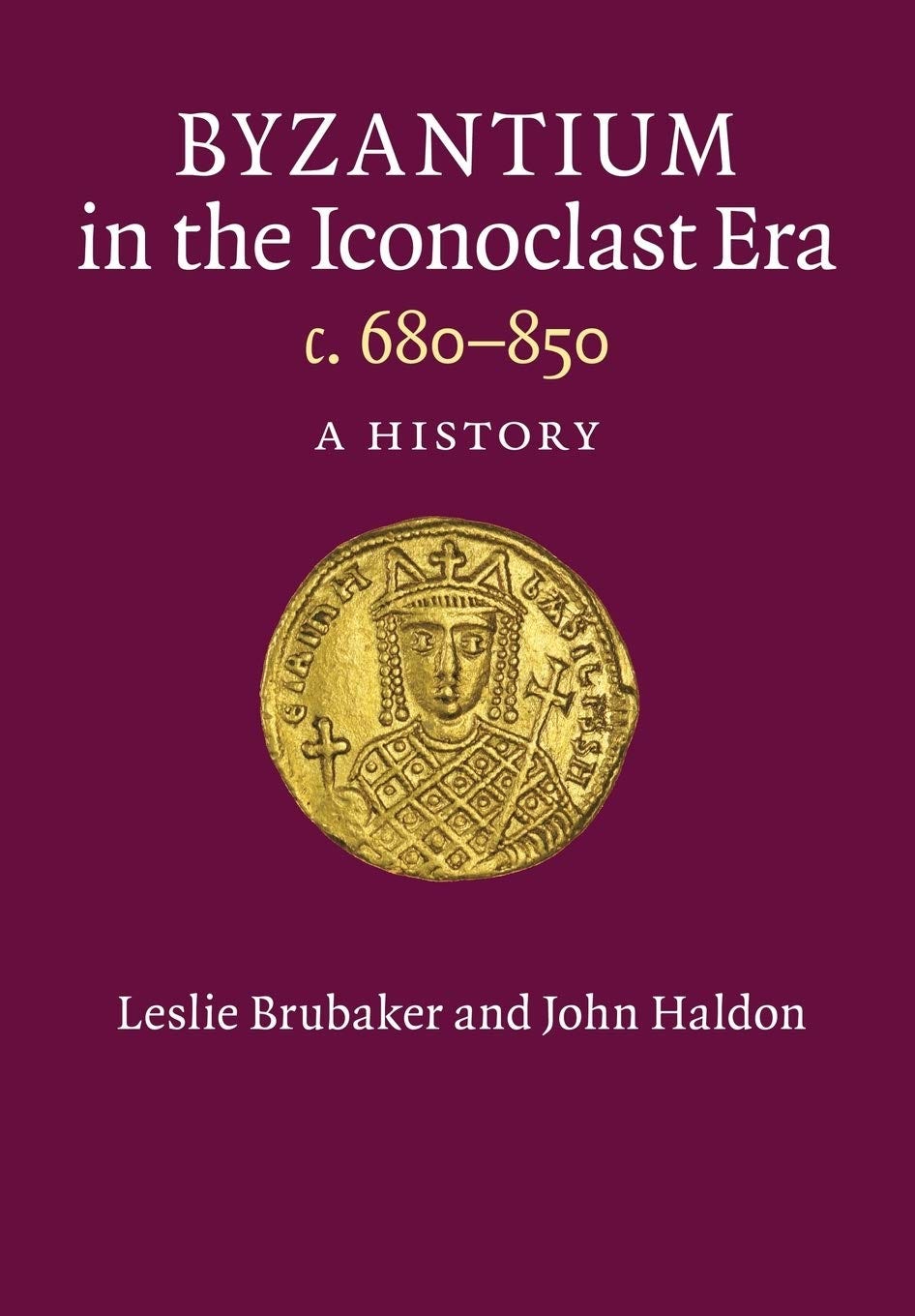
It was a landmark achievement for these scholars, who posited a late seventh century revision to the history of Byzantine Iconoclasm. Shortly after this release, the responses to their work began. Not everyone felt the way they did about this late date for the rise of the icon.
Jaś Elsner is an art historian who attained his doctorate from King’s College Cambridge in 1991. He is a faculty member for the University of Oxford, the University of Chicago, and The British Museum. In 2012, he responded to Brubaker’s work with an article titled “Iconoclasm as Discourse”, a synthesis of over two decades of his work in Late Antique Roman art. This work was cited in Part 1 of this series. Here is the relevant citation for our purposes:
We possess patristic writings, such as the letter of Epiphanius of Salamis to John of Jerusalem (and a number of other works by Epiphanius, who died in 403 CE), that represent the doubts of at least one significant fourth-century bishop and distinguished theologian as to the appropriateness of image worship by Christians (as well as attesting to its widespread practice) and articulate an iconophobic if not fully iconoclastic position—although Epiphanius tore down a curtain inside a church decorated, as he tells us, "with an image of Christ or one of the saints." This text and others—such as the letter of Eusebius (263-339, bishop of Caesarea and Constantine's biographer) to Constantine's half-sister Constantia arguing against the use of an image of Christ—may be forgeries contrived by the iconoclasts in a much later period as patristic evidence for their position, but they may also be genuine.1
Elsner is saying that if we take Epiphanius’ work to be authentic (as many do), then this indicates widespread “image worship by Christians” in the late fourth century. This is another scholar that opposes the sixth to seventh century spectrum.
After discussing his own categories of Christianity, he then says this:
“On the level of material culture, we have no images from the early period that we can definitively prove to have been devotional icons, but equally, we cannot prove any of our surviving images were not usable as icons for veneration by someone. We have some portraits of saints (for example, the gold glass medallions of Christ and a number of saints from the Roman catacombs…) that have no obvious narrative context. There is every possibility that these kinds of images were put to private devotional use, whether in a funerary context, where the surviving materials were found, in a liturgical space, or in the domestic arena. Such Christian images appear to have pagan precursors—not only in the devotions performed before portraits but also in the corpus of votive or cult panels depicting deities or heroes, of which more than fifty survive from late antiquity and which are currently being assembled into a corpus.”2
We have much Christian material culture from the third and fourth century. The problem is that there are no texts that explicitly discuss how the extant images were used. As such, Elsner is okay with granting a very real possibility that the early images we have were put to “private devotional use”.
The early evidence is important. Since the 1970s it has been assumed that the “rise of the cult of icons in the sixth and seventh centuries… and not the origins of Iconoclasm… is the central problem of the Iconoclast Controversy.” This model of historical explanation (based on proximate causes—that is, a posited recent rise in the cult of icons—and in opposition to longue durée causes, such as the persistence of forms of damnatio memoriae) is fundamentally realist. That is, it assumes that because we have more textual evidence about the cult of images for the sixth to the eighth centuries, it means there really was more of a cult of images in that period rather than a shift in what texts decided to highlight: a shift, in other words, in rhetoric rather than reality. I do not myself see any reason for preferring reality to rhetoric as an interpretative historical move in this context, given the rich earlier evidence—up to the third and fourth centuries, say—for varieties of image cultivation, both pagan and Christian. The choice to privilege realism is a value judgment, and I myself would prefer to leave the matter open. It is possible there was no rise in the cult of images, just a rise in the textual noise about the cult in the materials that have survived to us.3
Most importantly, Elsner challenges the entire historiographical framework that started with Ernst Kitzinger in the mid-twentieth century.
What Elsner is saying is that just because there are more texts that attest to icon veneration in later centuries, it does not necessarily mean that the practice of icon veneration came later too. Textual attestation does not always equate to a real attestation.
This is not fringe speculation. It is a senior Oxford scholar questioning whether the allegedly late “rise in the cult of images” is real or rhetorical. According to him, it is possible that was never a “rise in the cult of images”. In other words, it is quite possible that the cult of images was always there but it was just not written about at the time.
There is also a mention of pagan panel portraits that serve as a precedent, “…of which more than fifty survive from late antiquity and which are currently being assembled into a corpus”. By 2016, this corpus was assembled and the findings were published, with a surprising conclusion.
The Dawn of Christian Art
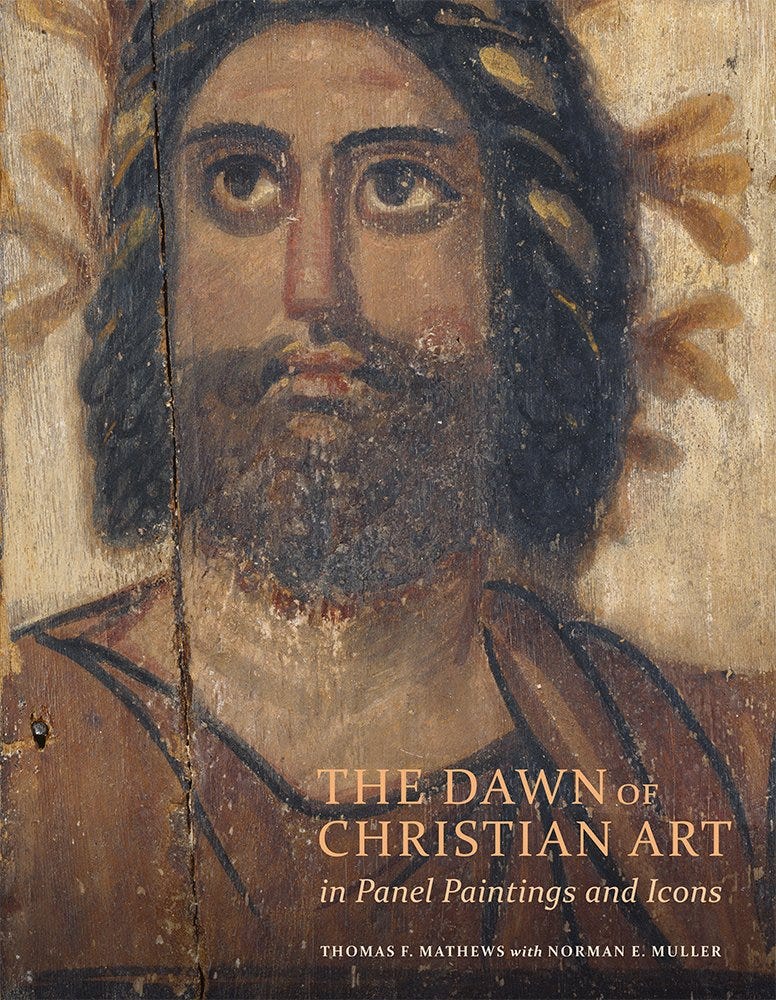
Thomas Mathews is a professor emeritus at New York University’s Institute of Fine Arts and Norman Muller is a conservator at the Princeton University Art Museum. They were assisted by a Samuel H. Kress Foundation Grant and a Getty Collaborative Research Grant to study a series of Roman and Egyptian panel portraits from the first to the fourth centuries AD.
Following this exhaustive study, they released their conclusion in 2016 under the publishing wing of the J. Paul Getty Museum in The Dawn of Christian Art. In this book, they contend that:
“Cult is the most contested issue of modern icon study, as a sizable contingent of scholars agree with Mango and Brubaker that the veneration of images had no place in early Christian worship. But our project explores evidence to the contrary. We believe that the cultic use of panel paintings was a continuous tradition from antiquity into Christianity. That tradition evolved and developed, it expanded and contracted, and the images that it generated continued to change, yet it seems to remain as a strong line of cultural continuity and deserves to be studied as such.”4
Here is peer-reviewed art-history scholarship funded by two separate foundations and published with the support of the Getty Art Museum directly undercutting the Kitzinger/Brubaker spectrum by centuries and providing a continuity view of the cultic use of panel paintings by Christians. What is even more interesting is how this book influenced one of the authors that contributed to A Companion to Byzantine Iconoclasm.
A Companion to Byzantine Iconoclasm
Dr. Gavin Ortlund has repeatedly directed his audience to Brill’s 2021 A Companion to Byzantine Iconoclasm as a volume that shows a sixth to seventh century consensus.
However, we need to take a look at how this book is assembled:
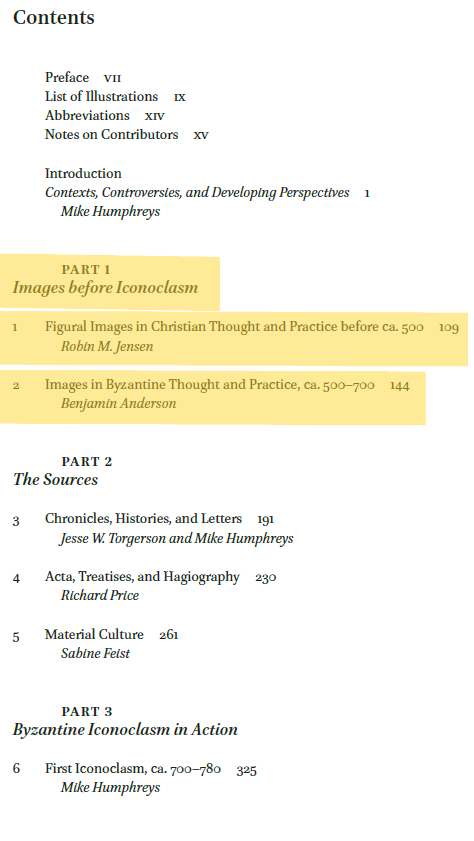
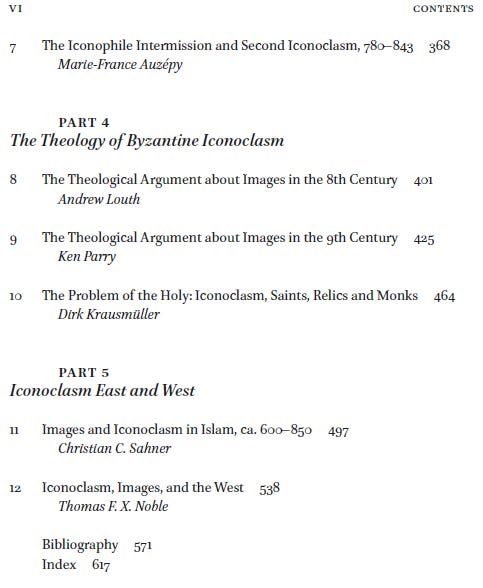
A free version of the Table of Contents can be found at the Brill online store: https://brill.com/edcollbook/title/34427
There are only two chapters that discuss icons before iconoclasm. All of the rest of the chapters were written to discuss other aspects of Byzantine iconoclasm; primary sources, eighth and ninth century history, Byzantine theology, and iconoclasm in Islam and the West.
The first chapter is from Robin Jensen. Her chapter, we have already discussed at length. Her opinions directly challenge the Kitzinger-Brubaker Spectrum. This alone should make us question Ortlund’s dependence on this volume. However, Jensen’s article was covered in Part 4.
What is even worse for Ortlund’s case is the second chapter.

Benjamin Anderson, PhD
Benjamin Anderson is an Associate Professor from Cornell University and contributed to A Companion to Byzantine Iconoclasm with an article titled “Images in Byzantine Thought and Practice ca. 500-700”. It ties together the arguments and findings of Jaś Elsner and Thomas Mathews into a discussion of sixth through seventh century Byzantine Art.
“Indeed, to judge by the preserved panel paintings [studied by Mathews], the 6th-7th centuries were a period of untroubled continuity in the composition and execution of religious portraits.[2]”5
The second footnote cites Mathews’ Dawn of Christian Art that I mentioned earlier. Anderson explicitly challenges the 6th-7th century consensus brought forward by Kitzinger and Brubaker by highlighting the problem with how they have treated the textual and material evidence.
“Scholars (both “traditionalists” and “revisionists”) have tended instead to treat the preserved narrative texts as direct proxies for contemporary practice. And yet, as Jaś Elsner rightly remarks, shifts in the level of “textual noise” regarding the cult of images need not (probably do not) directly reflect reality. They could result from any number of different causes: interpolation, yes, but also changing generic conventions and accidents of preservation.”6
He continues on the next page after outlining his upcoming discussions of texts and images, that:
“It is, namely, necessary to abandon a “line-graph” approach to the earlier centuries: one that seeks first to chart fluctuations in “the power of images” by collecting attestations in the preserved narrative sources, and then to identify proximate causes for those changes.”7
He believes that, rather than finding a bunch of textual data regarding Christians and their art, we need to chart a new course for interpreting the discourse of Christian art by seeing it as a semi-autonomous discourse throughout the centuries, contra Kitzinger and Brubaker.
“More importantly, we may question both Kitzinger’s initial impulse, and its perpetuation by Brubaker and Haldon, to chart the course of the “cult of images” on the basis of stray mentions in narrative sources. As Elsner remarks, such texts provide a very indirect proxy for practice: “It is possible there was no rise in the cult of images, just a rise in the textual noise about the cult in the materials that have survived to us”8
Anderson then turns to a body of evidence that has usually not been discussed: images that contain inscriptions. There are many attestations of images with inscriptions both in extant form and written about in texts. The advantage to this type of evidence is that it cannot be interpolated. The inscriptions are just there as complements to an image. Anderson highlights four types of inscriptions taken from Paolo Liverani.
Anderson notes the appearance of all these types of images throughout late Antiquity.
“Images were both surrounded by and engaged in conversation. People talked about pictures and to pictures; pictures talked to people and to themselves. The boundaries between viewers and images were porous and crossed repeatedly.”9
For the purposes of this discussion, type B is important, an external speaker addresses a figure in the image. Anderson explains on page 161 how these types of inscriptions provoked specific responses from viewers:
“…the viewer stands before the image, reads aloud what is written, and by consequence addresses the figure represented.”10
Regardless of the content of the inscription, “…in all cases the viewer addresses the being while confronting its image”11
Anderson gives an example of this in an ivory in the British Museum, believed to be dated to the sixth century, which contains the inscription “Receive the supplicant before you, despite his sinfulness”.12
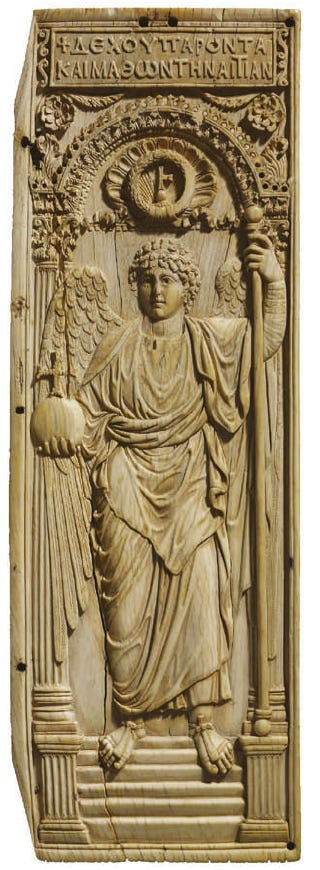
Image Credit: Benjamin Anderson, “Images in Byzantine Thought and Practice, ca. 500–700,” in A Companion to Byzantine Iconoclasm, ed. Mike Humphreys, Brill’s Companions to the Christian Tradition 99 (Leiden: Brill, 2021), 162.
Anyone that would have picked up this ivory would have read the inscription and engaged in a “prayerful dialogue”13 with the depiction.
Anderson then says this:
“The second-person inscriptions provide evidence, stronger still than the stories collected by Kitzinger, of a widespread cultural understanding that an image can – to borrow the formulation of Brubaker and Haldon – “serve as an intermediary between the viewer and the holy person represented.” This understanding was available well before 680: certainly by the 6th century, and probably much earlier. Indeed, rather than pose a choice between Kitzinger’s tipping point (ca. 550) and Brubaker and Haldon’s (ca. 680), we should consider the address to an agent through its representation as a near constant in the long-term history of Greco- Roman art.”14
The second chapter of A Companion to Byzantine Iconoclasm posits a “near constant” approach to images that involve viewing them as intermediaries between the viewer and the person depicted. This is the most fundamental building block principle that establishes icon veneration.
Anderson does not give a date for icon veneration but he grounds his research from Elsner who says that “It is possible there was no rise of the icon…” and from Mathews/Muller who assert that “…the cultic use of panel paintings was a continuous tradition from antiquity into Christianity.”
This continuity view (or something very close to it) entered mainstream scholarship in 2021 via A Companion to Byzantine Iconoclasm. Even if it has not yet attained the momentum needed to displace the Kitzinger-Brubaker spectrum from its position as the scholarly consensus, it is still a peer-reviewed, credible, and now mainstream position held by secular art historians today.
What is most concerning is that Ortlund should have been aware of this. He read Anderson’s opinion, yet this continuity view was never disclosed to his audience. He has cited from A Companion to Byzantine Iconoclasm’s introduction and first chapter in his icon polemics.
In March of 2025, Seraphim Hamilton and Dave Sims pointed out Anderson’s “near constant” viewpoint in a response to Ortlund.15
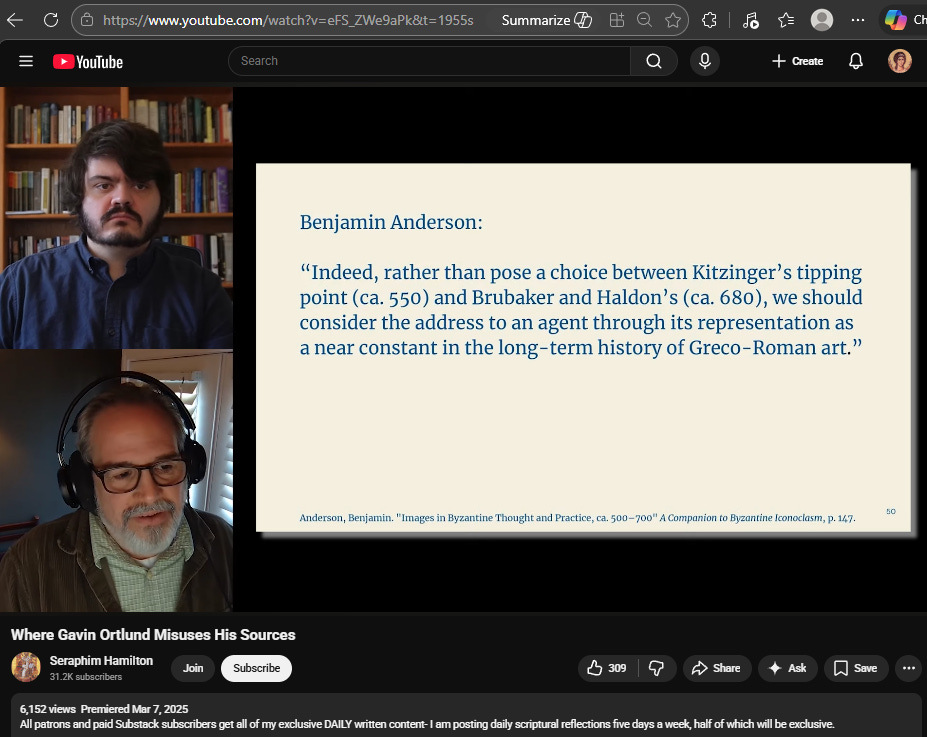
Screenshot taken on April 4th, 2026
Ortlund replied to them in the comments:16
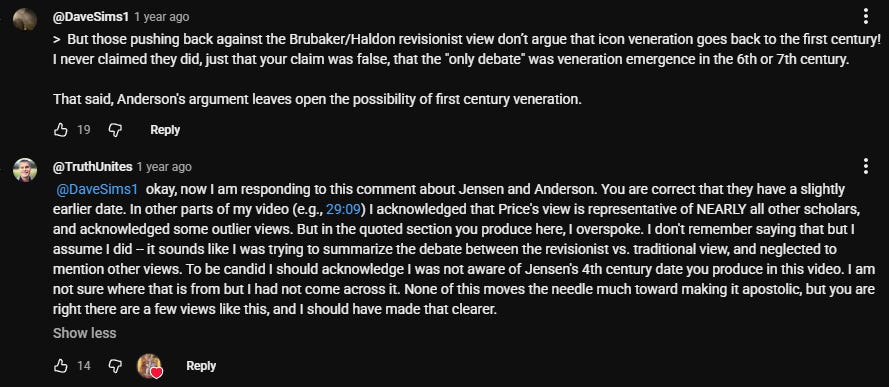
“okay, now I am responding to this comment about Jensen and Anderson. You are correct that they have a slightly earlier date.”
Screenshot taken on April 4th, 2026
Slightly earlier date?
Let’s put together the screenshots of Ortlund’s comment and Anderson’s article to discern Anderson’s position relative to the sixth to seventh century spectrum.

Screenshot taken on April 4th, 2026
Ortlund says that Anderson has a “…slightly earlier date.”
Anderson says “certainly by the 6th century, and probably much earlier.”
Slightly Earlier.
Much Earlier.
These are mutually exclusive statements.
Ortlund has attributed to Anderson a viewpoint that was mutually exclusive to what Anderson was actually trying to say. This is a clear lapse in accurately representing Anderson’s view.
But this is not the only scholar from the Companion that holds a view similar to this.
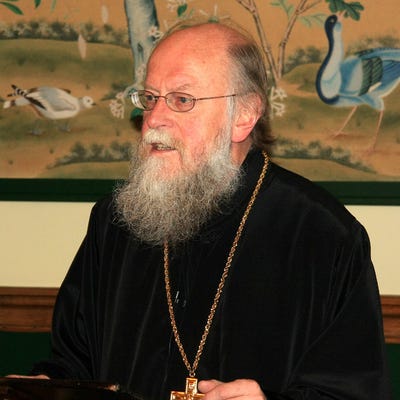
Andrew Louth, PhD
Father Andrew Louth is a former Anglican Priest that converted to Eastern Orthodoxy in 1989 and was re-ordained in 2003. He has been a faculty member for the University of Durham since 1996, and has published respected literature on St. John of Damascus and a 2007 book, Greek East and Latin West which covers church history from 681 - 1071 CE. He also contributed an article to the Companion book which covered the theology of images in the eighth century. He does not state his opinion on the emergence of icon veneration in this article, mostly because the purpose was to discuss eighth century image theology. But has he published his opinion elsewhere?
Yes, he has. This is an extended excerpt from his 2007 book Greek East and Latin West:
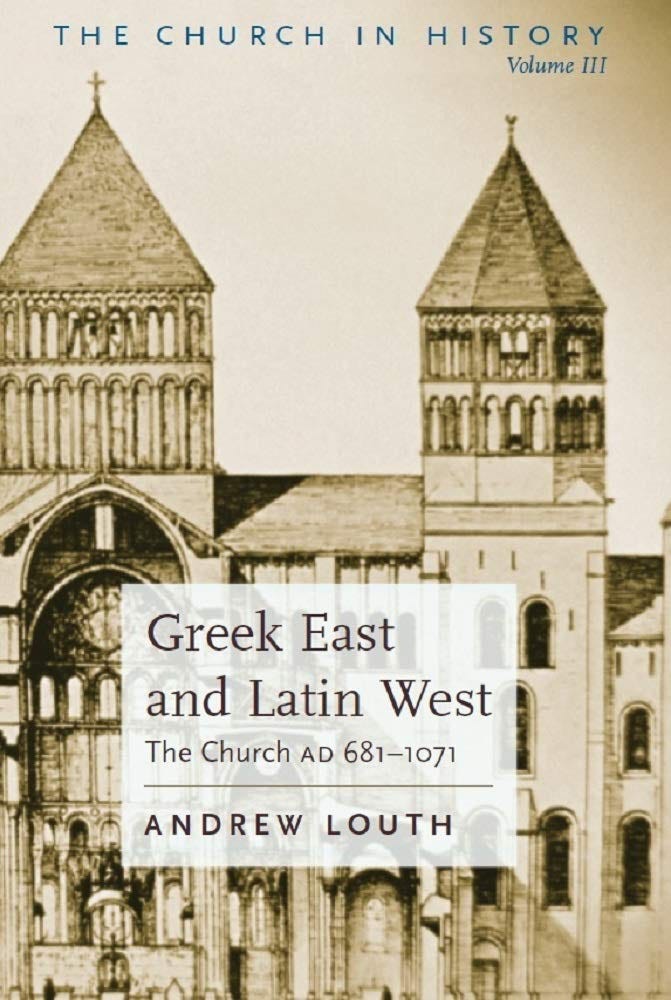
At the heart of the iconoclast controversy was a question about tradition: were icons part of the tradition, indeed the apostolic tradition, of the Church, or were they a later innovation? The iconoclasts were clear that icons were no part of the apostolic tradition of the Church, but an innovation that had been resisted by some, at least, of the Fathers, but which had spread, like a cancer, throughout the Church. Those who defended the making and veneration of icons regarded them as an apostolic tradition, to which the Fathers could be demonstrated as having given their full support. Modern scholarship on this question has, almost universally, taken the side of the iconoclasts; for most scholars it is beyond question that icons and their veneration are a late phenomenon in the life of the Church. This is often represented as the triumph of popular devotion, still in thrall to the polytheistic paganism to which it had been accustomed, and which found expression for its religious needs in the cult of the saints and the worship of their images. The Church is seen as having abandoned the austere aniconism it had inherited from the Jewish Synagogue, succumbing to the religious customs of the Mediterranean world, where it had established itself. Of such a caricature of the history of images in the Church, it needs to be said that the starting point—the aniconic Jewish Synagogue—is a later development, not something the early Christians would have been familiar with: the synagogue at Sepphoris in Palestine, one of the centres of Rabbinic Judaism after the fall of the Temple, and the famous synagogue at Dura Europos bear witness to that. It is true that the history of religious art in early Christian worship is unclear in the extreme: the archæological evidence, though scanty, provides evidence for Christian art quite early on, but the literary texts do not give us enough help in interpreting it. Evidence becomes more abundant from the fourth century onwards, but that is simply because all evidence of Christian belief and practice becomes more abundant once Christianity ceased being persecuted. There is very little evidence of Christian opposition to religious art as such: the iconoclasts adduced texts from Eusebios of Caesarea and Epiphanios of Salamis, but, even if these texts could simply be accepted as authentic (and in the case of Epiphanios, in particular, there are problems both of interpretation and authenticity), it does not amount to very much. Other patristic objections adduced to Christian art—for instance, Severos of Antioch’s objection to angels being depicted as military generals—are not objections to Christian art as such.
Nevertheless, it is in the fifth and sixth centuries that we begin to find plentiful evidence of a developed cult of icons.17
Louth places developed cultic evidence in the fifth and sixth centuries but sees the absence of widespread opposition as evidence against any notion of recent novelty. He also dismantles the supposed Jewish aniconic baseline: the synagogues at Dura-Europos and Sepphoris show figurative art was not foreign to early Jewish practice.
We still have not made it to his opinion yet. However, the extended citation above shows Fr. Louth’s ability to effectively summarize the scholarly opinions in play during the time of publication, 2007.
Further down is a clear statement on his assessment of the evidence.
“Apart from the few texts adduced by the iconoclasts… there is virtually no evidence of any Christian reaction against veneration of icons, which tells against any idea that such veneration was a sudden innovation in the sixth century (or even the fourth).”18
Or even the fourth.
Fr. Louth is a part of the scholarship who contributed an article to A Companion to Byzantine Iconoclasm, and he argues for icon veneration before the fourth century.
Let this sink in.
Three authors from A Companion to Byzantine Iconoclasm disagree with the Kitzinger-Brubaker spectrum. Ortlund may not agree with Louth, Jensen, or Anderson. That is fine. The issue is that Ortlund has persistently framed the Brill volume as if it unilaterally supports only Kitzinger and Brubaker’s opinions. Jensen, Anderson, and Louth have origin viewpoints that predate this and do not feature in Ortlund’s presentation. This is the most generous statement from Ortlund about outlier views:19
“What Price says is just representative of what nearly everybody says, except for a few outlier views. You could see Mike Humphreys in his outstanding article in this more recent book if you want to get a really, really recent overview of both the historical evidence and the scholarship. What he concludes is that what the iconoclasts were reacting against was the recent—from circa 680—transformation of images of Christ and the saints into icons through which the holy person depicted could be manifested.
Any mentions of icon veneration before this point are either interpolations (that means later textual additions) or referring to, basically these are, images that are also relics, and those are just from a little earlier in the 7th century.
So the only debate there is exactly where you’re setting the dial for when it’s coming in. That 680 date is coming from, in large part, this great 900-page book from Cambridge University Press that came out in 2011. Their position is very clear: they say the iconoclasts of 754 were right when they condemned image veneration as an innovation. So that’s referring to the Council of Hieria. There was also a very large council which took the opposite view.
All of that’s completely standard. The only debate is, are we talking about the late 6th century (the earlier view) or the more common and more plausible view today—the late 7th century—that icon veneration is coming into the church. Nobody thinks that the Cappadocian fathers bowed down before images, let alone the apostles.”
29:05 – 30:45
Even Ortlund’s qualifier about there being outliers to the 6th-7th century consensus does not incorporate any idea that there were Cappadocian-era views of the emergence of icon veneration (late fourth century or earlier). The problem is that, based on the very sources that he read, Ortlund should have known that this statement was wrong at the time that he said it.
Watch this clip from his now unlisted 2021 video, Venerating Icons: a Protestant Critique.20
“I actually think it’s really enriching for evangelical Protestants to engage these issues and this conversation too. Often we just ignore them and we don’t even know what the arguments are — we’re just responding impulsively or emotionally. We really need to listen to the arguments that John and others are making from the incarnation and elsewhere.
And just knowing this whole history… I’ll never forget reading through this book — not to sound like too much of a nerd here, but probably if you watch my channel you already know how much of, but uh — but it’s Greek East and Latin West by Andrew Louth, the same guy, same press as well. This is a history of the church from 681 to 1071, really looking at the East especially, and it gives a lot of attention to the iconoclast controversy. It’s fascinating.
So Protestants, we need to engage this carefully and listen to the arguments from the other side.”
Venerating Icons: A Protestant Critique, 5:42– 6:34
Yes, Ortlund has read the book from Andrew Louth that I have just cited. “I’ll never forget reading through this book”. Ortlund had his eyes on Louth’s opinion in 2021.
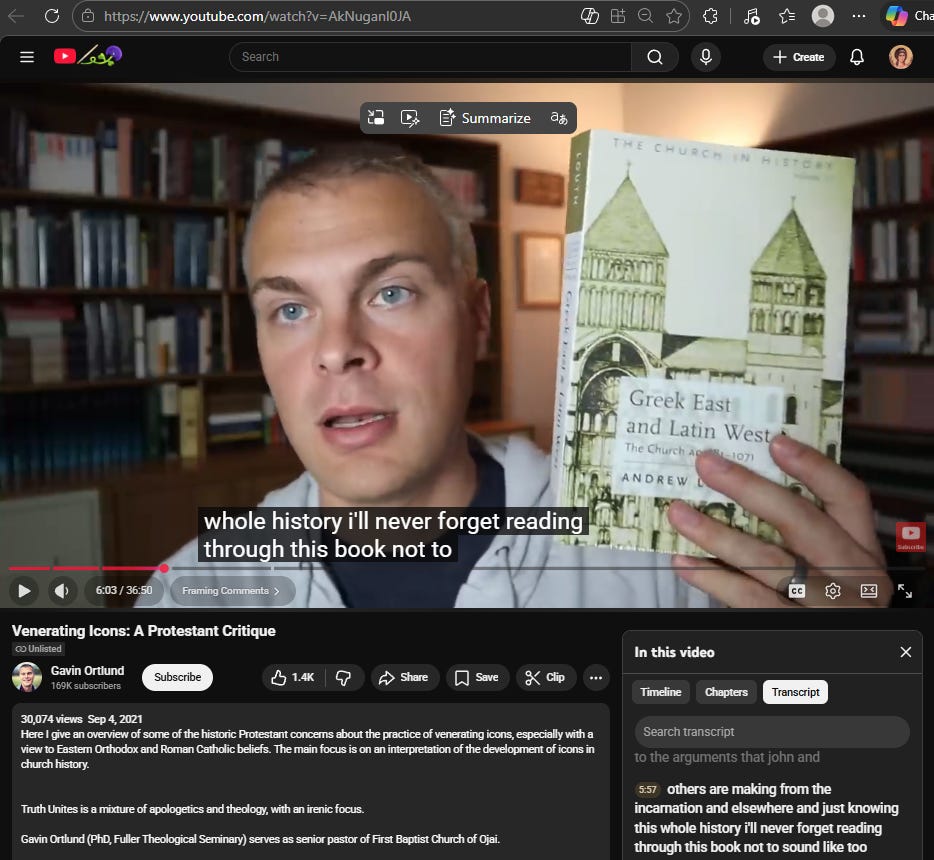
Maybe he glossed over it. Maybe he forgot about this quote. Maybe he knows about Louth’s opinion but omitted it. It is not my place to say why Louth’s opinion does not feature, even though he is a respected enough figure in the field to be a contributor to A Companion to Byzantine Iconoclasm.
But given the fact that:
1. Ortlund has read Andrew Louth’s book which espouses a pre-fourth century date to icon veneration
2. Ortlund has read A Companion to Byzantine Iconoclasm, where Louth is featured as a respected, contributing scholar to the conversation in chapter eight.
3. The following statement from Ortlund, “Nobody thinks that the Cappadocian fathers bowed down before images, let alone the apostles,” should have never been said.
An anticipated objection looks something like this: ‘Sure, Louth has a pre-Nicene opinion on the subject. But he’s an Eastern Orthodox priest, of course he’s going to have that opinion. He’s biased.’
My response: ‘Then why does Ortlund cite a Roman Catholic priest favorably when it supports his case, yet omit the published opinions of an Eastern Orthodox priest on the same historical period — Byzantine Iconoclasm?’
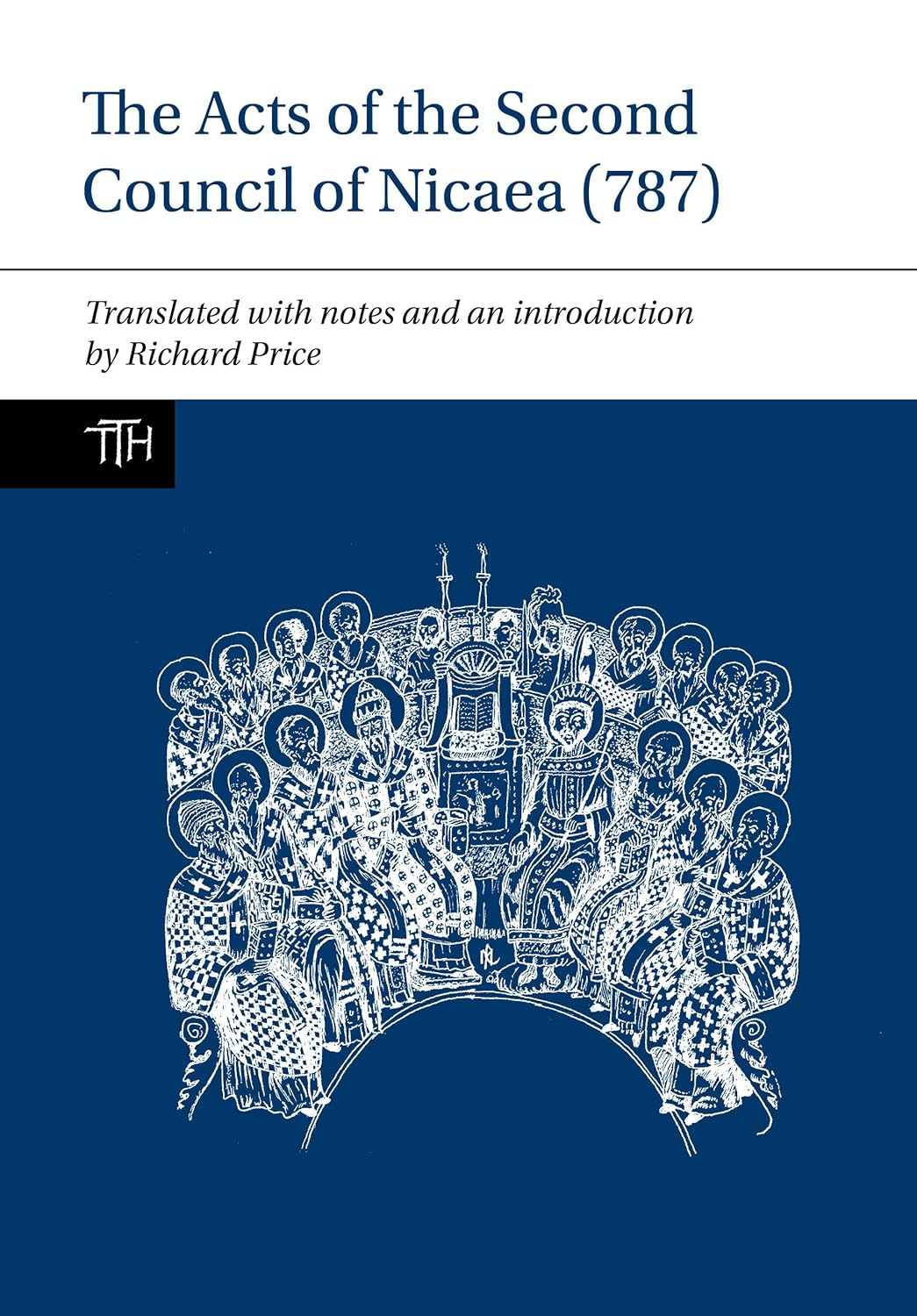
Father Richard Price
Dr. Gavin Ortlund repeatedly cited from the introduction to Father Richard Price’s translation of The Acts of the Second Council of Nicaea (787) to support his sixth to seventh century claims for years.
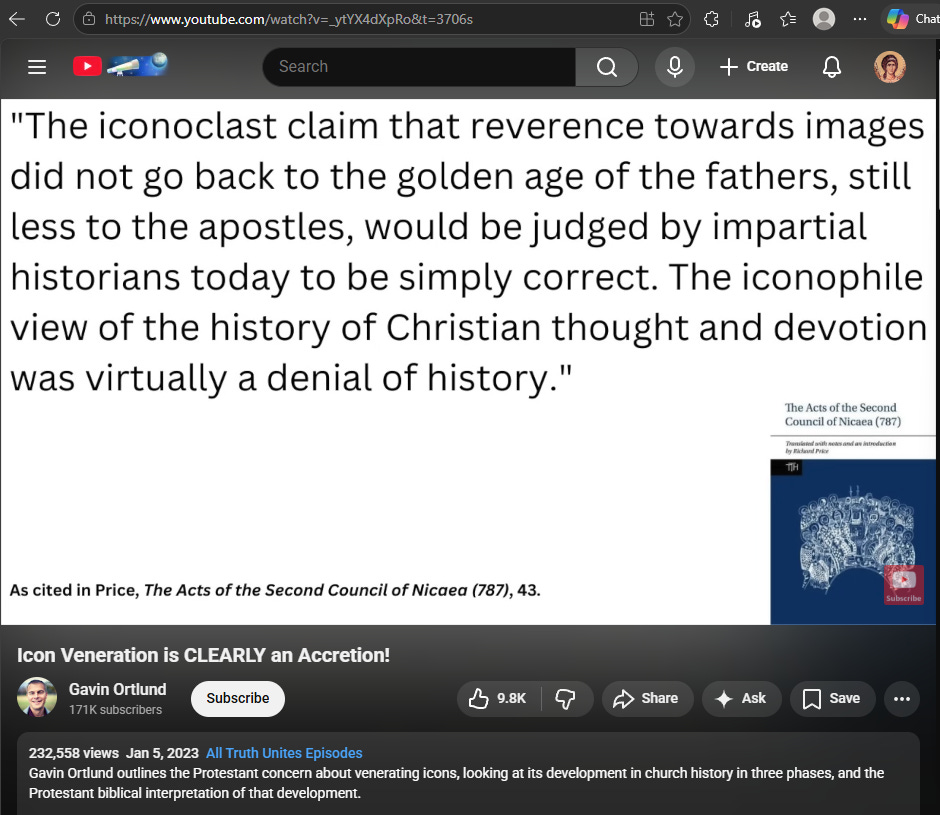
Ortlund, Icon Veneration is CLEARLY an Accretion!, 14:23, January 5th, 2023.
Screenshot taken on April 6th, 2026.
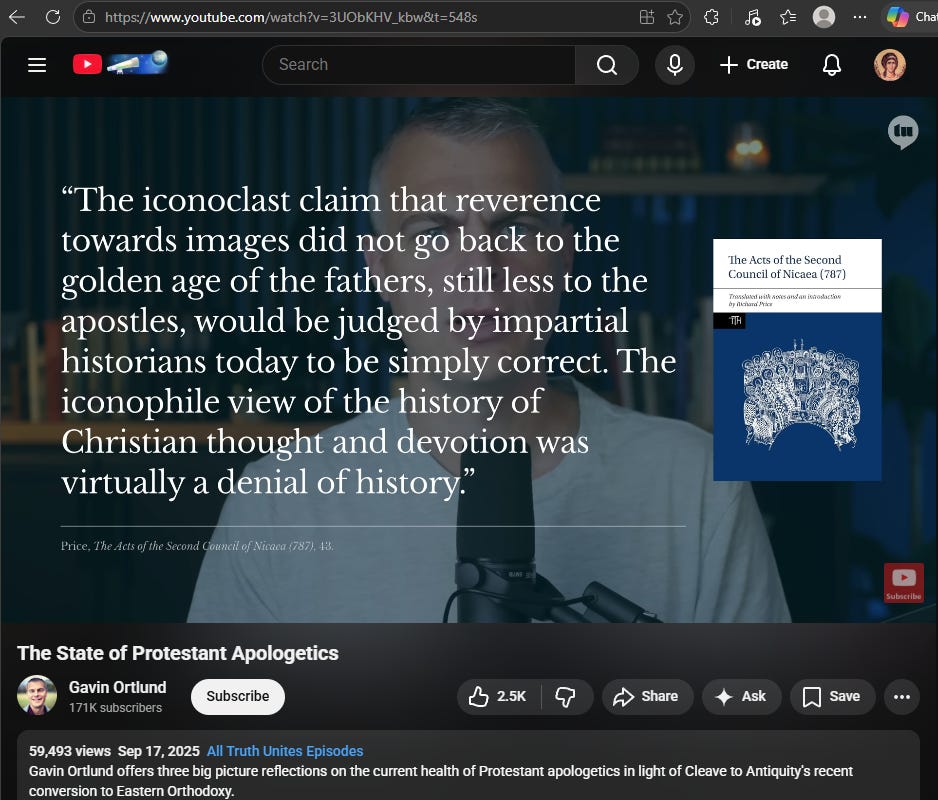
The State of Protestant Apologetics, 9:06, September 17th, 2025.
Screenshot taken on April 6th, 2026.
As we have seen with many of his quotes, Ortlund’s citation of Price contains ellipsis errors. However, in this case, the context does not significantly change when the quote is restored. It is simply worth noting another instance in which Dr. Ortlund has improperly cited a source outside standard citation practice.
“The iconoclast cause has few adherents nowadays, outside the heirs of John Calvin. But the iconoclast claim that reverence towards images did not go back to the golden age of the fathers, still less to the apostles, would be judged by impartial historians today to be simply correct. The iconophile view of the history of Christian thought and devotion was virtually a denial of history…”21
Citation errors aside, this is still a strong statement from a relevant scholar. However, it is still only an introduction to the acts of an eighth century council, not a comprehensive review of early Christian material culture. Up to this point, everything that I have cited is well within the peer-reviewed scholarly discourse on Early Christian Art. There are a wide diversity of nuanced, credible opinions that differ on the dates the rise of image veneration.
Compare this diversity to Father Richard Price’s bibliography. His bibliography is certainly extensive. Brubaker and Kitzinger were cited as main contenders on this subject.
But who is not cited:22
Jaś Elsner or Paul Corby Finney are not,
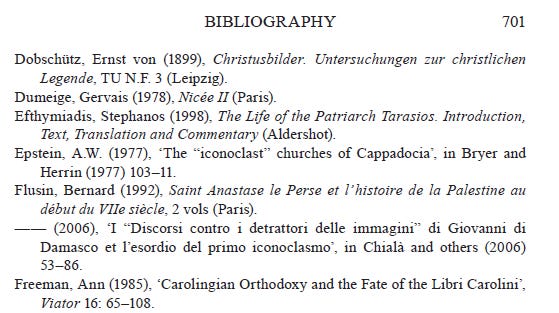
Robin Jensen is not,
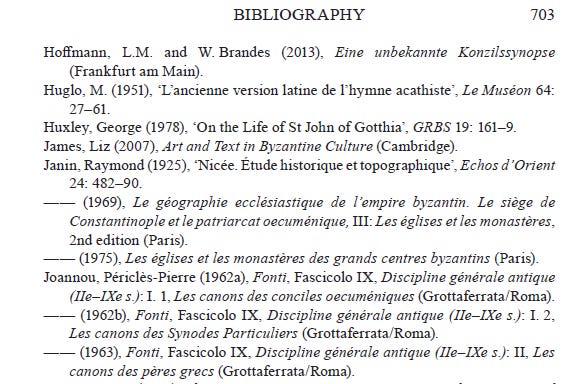
Thomas Mathews is personally referenced on page 565 of Price’s translation, but his 2016 book “Dawn of Christian Art” is not referenced.
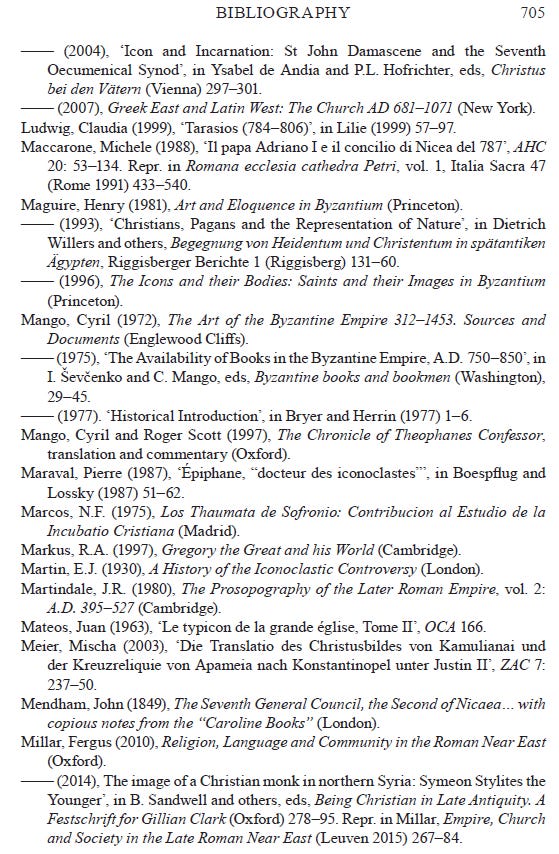
Andrew Louth’s work is cited, but Louth’s opinion on the origins of icon veneration is not detailed.
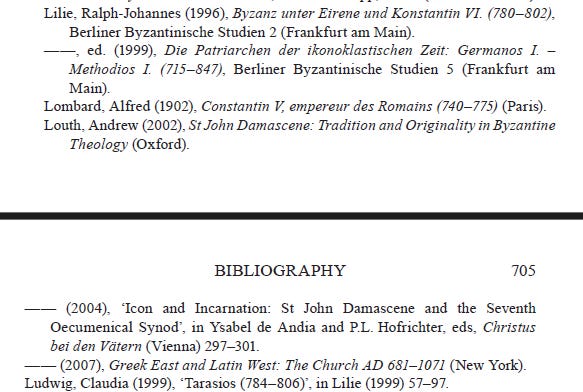
Fr. Richard Price’s introduction to the Second Council of Nicaea is just that, an introduction. A primer. It is not an exhaustive commentary on all of the scholarly opinions that are out there. Unfortunately, Ortlund appears to have latched on to Price’s quote and over-relied on it. A true summary of the scholarship from Dr. Ortlund as it stood in 2023 should have acknowledged that the long-held sixth to seventh century consensus was then being substantively challenged by early Christian art historians. On the origins of Christian icon veneration, the opinions by the 2020s were becoming wide, diverse, and nuanced.
A Plurality of Views
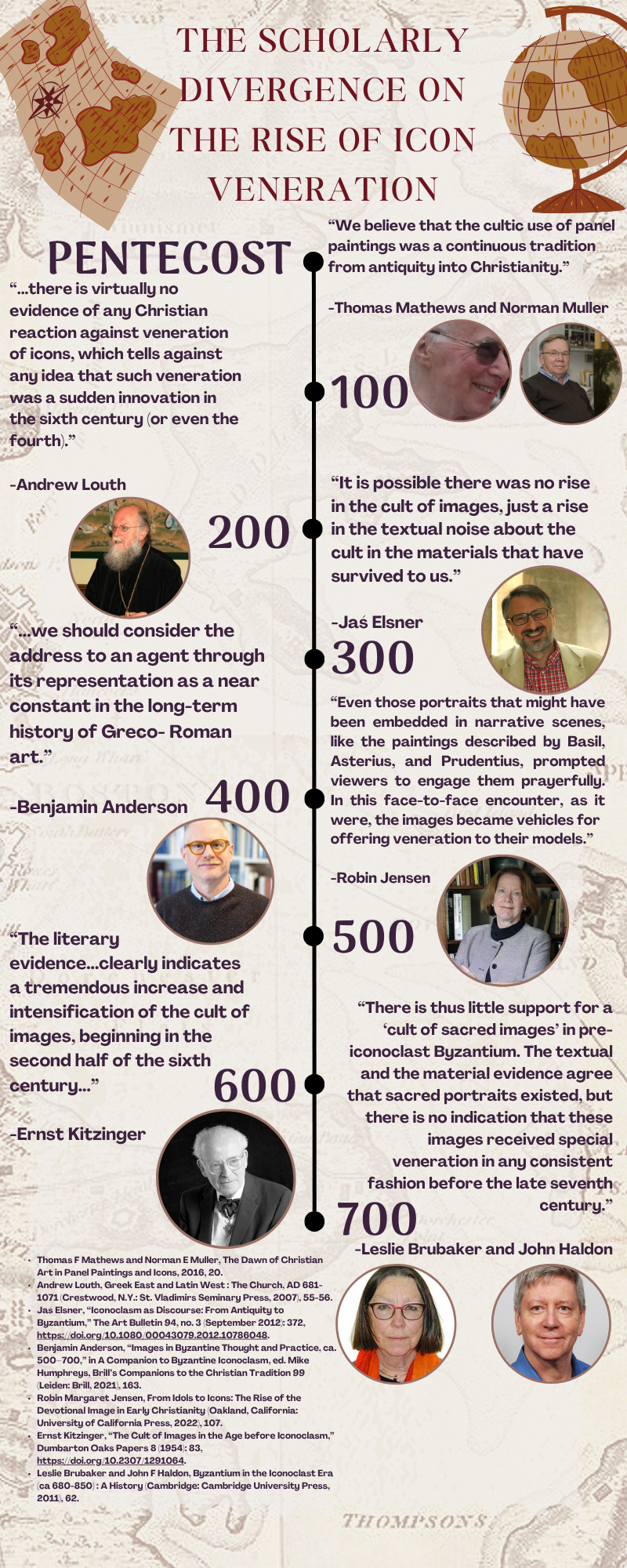
From the revisionist late seventh century claims of Brubaker to the classic sixth century opinion of Kitzinger, the late fourth century origin dates of Jensen, the near-constant understanding of Anderson, the pre-fourth century view of Louth, and the continuous tradition stance of Mathews and Muller, everyone has taken a stance somewhere on the timeline of early Christianity.
What is most unfortunate about this is that Ortlund has read much of this scholarship. He has read Louth. He has read Brubaker and Kitzinger. He has read Jensen and Anderson. Yet his public presentation of the scholarship does not reflect this diversity.
The deconstruction of Dr. Gavin Ortlund’s modern aniconism is nearly complete. However, there is still one topic left to discuss.
The end of Ortlund’s icon chapter from What it Means to be Protestant says this:
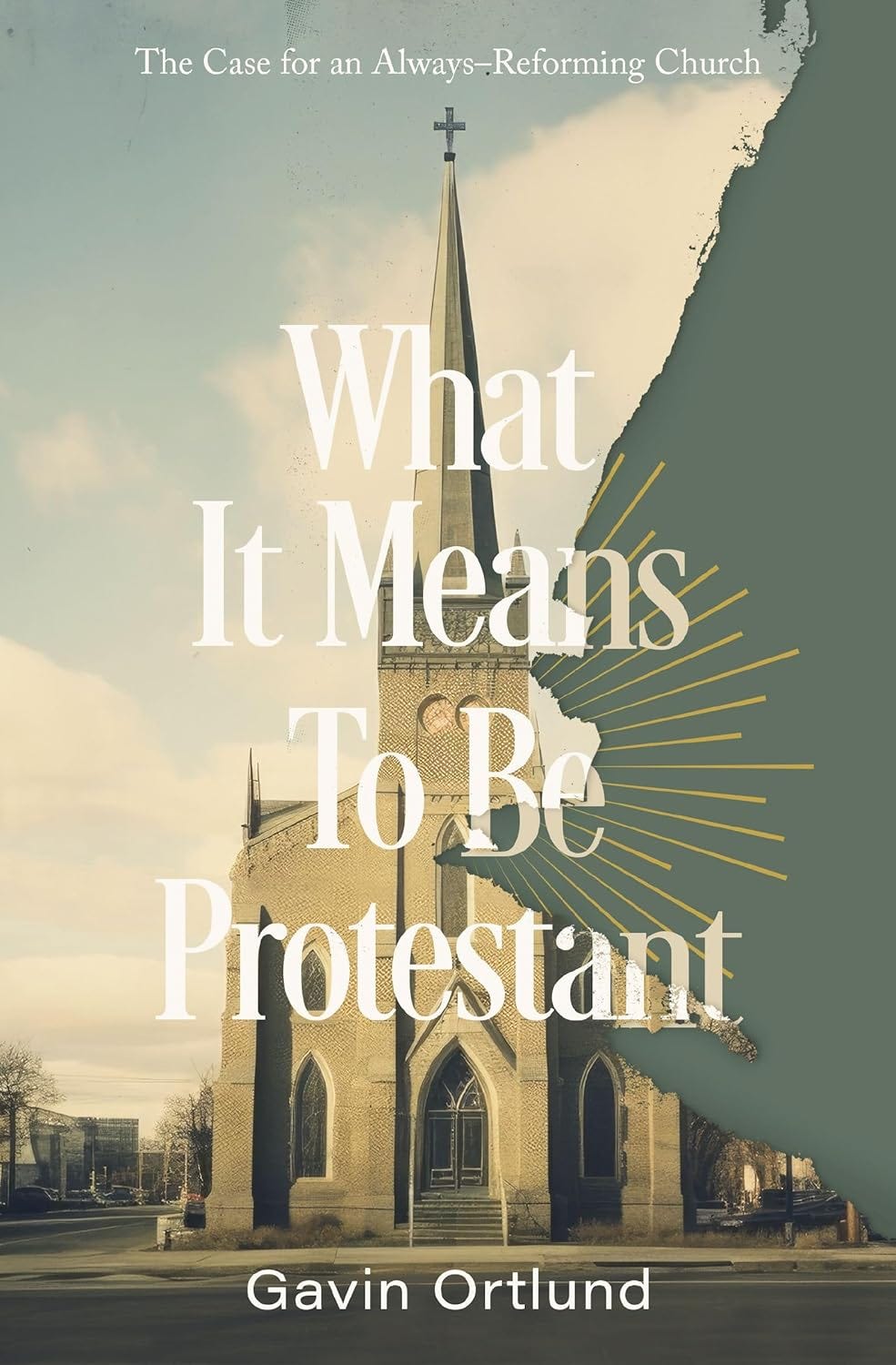
“The Protestant tradition, by contrast, offers us a pathway of meaningful return to the practice and theology of the early church, as well as to that of later contexts like the Council of Frankfurt.”23
It is time to examine this claim to see if the Council of Frankfurt can provide this pathway of meaningful return to the early church. In so doing, we will find an error so pervasive that it will completely undermine the claim that Protestants can truly be deep in history.
Jaś Elsner, “Iconoclasm as Discourse: From Antiquity to Byzantium,” The Art Bulletin 94, no. 3 (September 2012): 371, https://doi.org/10.1080/00043079.2012.10786048.
Elsner, “Iconoclasm as Discourse”, 371-372
Elsner, “Iconoclasm as Discourse”, 372
Thomas F Mathews and Norman E Muller, The Dawn of Christian Art in Panel Paintings and Icons, 2016, 20.
Benjamin Anderson, “Images in Byzantine Thought and Practice, ca. 500–700,” in A Companion to Byzantine Iconoclasm, ed. Mike Humphreys, Brill’s Companions to the Christian Tradition 99 (Leiden: Brill, 2021), 144.
Anderson, “Images in Byzantine Thought and Practice,” 147
Anderson, “Images in Byzantine Thought and Practice,” 148
Anderson, “Images in Byzantine Thought and Practice,” 157
Anderson, “Images in Byzantine Thought and Practice,” 160
Anderson, “Images in Byzantine Thought and Practice,” 161
Anderson, “Images in Byzantine Thought and Practice,” 161
Anderson, “Images in Byzantine Thought and Practice,” 161
Anderson, “Images in Byzantine Thought and Practice,” 161
Anderson, “Images in Byzantine Thought and Practice,” 161-163
Seraphim Hamilton, “Where Gavin Ortlund Misuses His Sources,” YouTube, March 7, 2025,
ibid. Comments Section.
Andrew Louth, Greek East and Latin West: The Church, AD 681-1071 (Crestwood, N.Y.: St. Vladimirs Seminary Press, 2007), 53-55
Louth, Greek East and Latin West, 55-56
Gavin Ortlund, “Icon Veneration Is STILL an Accretion (Response to Hamilton/Garten),” YouTube, May 20, 2024,
, 29:00 – 30:45. It should be noted that the video contains a pinned comment from Ortlund clarifying his statement about what Humphreys actually concluded. In short, Humphreys was summarizing the position of Brubaker in the cited reference but not giving his own opinion in the citation.
Gavin Ortlund, “Venerating Icons: A Protestant Critique,” YouTube, September 4, 2021,
, 5:42– 6:34.
Price, The Acts of the Second Council of Nicaea, 43
The following bibliography screenshots are taken from Price, The Acts of the Second Council of Nicaea, 701, 703, 704, 705.
Gavin Ortlund, What It Means to Be Protestant (Zondervan, 2024), 218.